Tuesday, November 13, 2012

Global Gaming Spotlight: La Abadía del Crimen (Spain)


With each post in this mini-feature, I highlight a game from a different country around the world. Keep in mind these aren't necessarily the best or most popular games from each nation, but simply a fitting representative.

La Abadía del Crimen - Opera Soft, 1987

Most of the games I've written about so far in this series have been either modern games or well-known classic games. La abadía del crimen (The Abbey of Crime) is a bit more obscure--it was never even officially translated to English or released outside its home country. While Spain isn't a major producer of video games today, the nation went through a golden era in the 1980s when it was second only to the UK in terms of European game production.

La abadía del crimen is perhaps the most important of these Spanish titles from the '80s. Originally meant to be a direct adaptation of Italian philosopher Umberto Eco's first novel The Name of the Rose, the game is about a Franciscan monk solving murders taking place in his abbey.


The game was notable for being one of the first to exist over a specific period of time--it's split into seven days further split into Canonical hours. In addition to solving the crimes, the player must still carry out their daily routine as a monk. If they're late for services or caught wandering around at night, the abbot kicks the monk out of the abbey and ends the game.

This fleshed-out gameworld, explored with a rudimentary 3D isometric map of the abbey, was decades ahead of its time. The game wasn't given the respect it deserved until the past few years. The game's creator, Paco Menéndez, committed suicide in 1999 at the age of 34.

Monday, November 12, 2012

Global Gaming Spotlight: Every Day the Same Dream (Italy)

With each post in this mini-feature, I highlight a game from a different country around the world. Keep in mind these aren't necessarily the best or most popular games from each nation, but simply a fitting representative.

Every Day the Same Dream - Molleindustria, 2009 (play it here)

I recently wrote a lengthy essay sparked by Molleindustria's newest game, Unmanned. Although the most famous videogame character of all time may be a fictional Italian, Italy hasn't had a huge history as a mainstay of the games industry. Recently, though, they've emerged with a number of high profiles in independent gaming, like Molleindustria and Fotonica creators Santa Ragione.

Every Day the Same Dream is about daily routine. It's about finding inspiration in the little things that break up this constant rhythm of adult life. While Molleindustria is known for its sociopolitical work--which is fantastic, by the way--this game is more about personal struggles. The developer also writes a fantastic blog on their site that's worth reading even if you don't play their games.


While the mainstream gaming industry doesn't want to touch politics with a ten-foot pole, Molleindustria embraces the concept of games as an activist medium. And their work is often not about the games' mechanics or "winning"--they're about sending a message or finding a feeling.

Saturday, November 10, 2012

Global Gaming Spotlight: QWOP (Australia)

 With each post in this mini-feature, I highlight a game from a different country around the world. Keep in mind these aren't necessarily the best or most popular games from each nation, but simply a fitting representative.

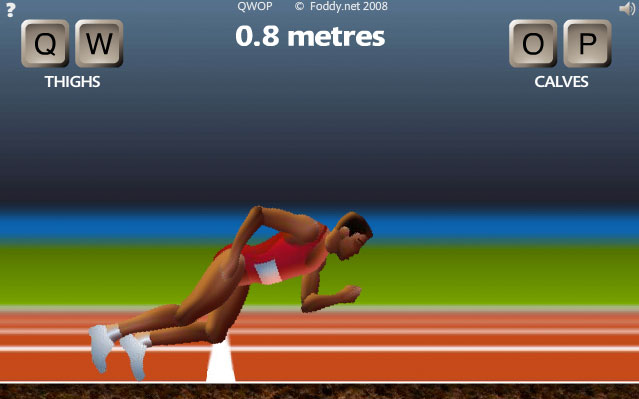
QWOP - Bennett Foddy, 2010 (play it here)

Along with Germany, Australia has been one of the Western world's greatest video game censors. When considering the a game to represent their industry, I was tempted to pick L.A. Noire--a title infamous for the working conditions and "crunch time" that publisher Rockstar Games imposed on Sydney developer Team Bondi, leading to the studio's demise despite their game's critical and commercial success.

No, I had to go with QWOP. Its creator Bennett Foddy (former bassist of Cut Copy) now lives in the UK as a professor at Oxford. He teaches things totally unrelated to games. But in his spare time, he's a pioneer of anti-gaming: games specifically meant to anger the player.


If you still haven't played the international sensation QWOP, you need to play it now. It's a commentary on the quest for realism in game design. Players must control each of the main character's thighs and calves individually to run in the Olympics, and... it's incredibly frustrating.

Foddy is showing us we don't really want true realism in our games. We don't want a game about running in the Olympics to be as difficult as actually running in the Olympics. We want games to be simplified approximations of real life that are easy to do and fun. He shows us the limitations of the conventions of the medium. Maybe our quest for "fun" is pointless after all.

Friday, November 9, 2012

Cultural History Through That Dancing He-Man Video

GameSpot is a gaming website with varying degrees of journalistic integrity. But they're one of the oldest game sites still in operation, and was doing video reviews before basically anyone else.

As part of my recent love affair with Deadly Premonition and its goofy creator Swery65, I watched a GameSpot video review of Swery's unremarkable 2001 survival-horror game Extermination. And then it hit me: "I'm watching an internet video that's over a decade old."

There are children old enough to read GameSpot who are younger than that video review. The internet's been around for a while now, eh? The great thing (and horrible thing) about the internet is... it's there forever.

We learn a lot through the layers of modern history we find in random places on the internet. Let's take a gander at the timeline of one of the internet's greatest classics: That Dancing He-Man Video, officially known as "HEYYEYAAEYAAAEYAEYAA":


What events led to this video with 26 million views? History layers itself.
  • 1982: He-Man is spawned with the creation of the Masters of the Universe media franchise. It's a super cheesy show aimed at prepubescent boys of the era.
  • 1993: Insignificant one-hit-wonder rock band 4 Non Blondes releases their only popular single, "What's Up?"
  • 2005: Prior to the ubiquity of YouTube, animation studio Slackcircus re-edits clips of Masters of the Universe to the tune of a dance-music version of the 4 Non Blondes song, and uploads the video to the Something Awful forums under the title "Fabulous Secret Powers." You can see the original video (now on YouTube) here.
  • 2010: YouTube user ProtoOfSnagem condenses Slackcircus' original video to its essential core song, and uploads it to the now-popular YouTube site under the fitting title "HEYYEYAAEYAAAEYAEYAA." Nothing in the video's description tells you anything about the video or its source, other than "please note I do not own this video."
Today, ProtoOfSnagem's verison of the video has 26.2 million views. If you search "He-Man" on YouTube, the first result is the He-Man opening theme. The second result is "HEYYEYAAEYAAAEYAEYAA."

4 Non Blondes' original music video for "What's Up?" was finally uploaded to YouTube in 2011, and while the song was mildly popular in the '90s, I can't help but think it was put on YouTube specifically because of the He-Man video. The music video currently has 10.2 million views on YouTube, and the majority of the video's comments relate to He-Man.

The dancing He-Man video has distinct markings of the time it was made--low resolution video, rudimentary editing techniques, and references to AOL Instant Messenger that today's youth probably don't understand.

In conclusion, an inconsequential alt-rock song from the 1990s is popular today because of a video of He-Man dancing. If we're seeing such evolution of the internet after only a few short decades of existence, it'll be fun to see where we are in a few more decades.

Global Gaming Spotlight - Spec Ops: The Line (Germany)

With each post in this mini-feature, I highlight a game from a different country around the world. Keep in mind these aren't necessarily the best or most popular games from each nation, but simply a fitting representative.

Spec Ops: The Line - Yager Development, 2012

Germany has a tenuous history with video games. Despite being the most populous country in Europe and an economic powerhouse, they simply haven't developed many games. Board games, yes, but not video games. And much like their board games, German video games tend to fall into the niche (or Nietzsche?) of hardcore strategy--not very accessible to mainstream gamers.

Much of this is a product of the German government's constant censorship of violence in games. It doesn't help that a significant chunk of gaming is dedicated to killing Germans. In recent years, Frankfurt studio Crytek has emerged as the highest-profile developer in Germany, but their games Far Cry and Crysis are more notable for their technological advancement than their actual gameplay.


Then this year, rookie Berlin studio Yager Development released Spec Ops: The Line. The developer doesn't even have its own Wikipedia page. On the surface, Spec Ops looks like yet another generic military shooter game. But it proved to be a deeper experience than meets the eye: A conventional story about U.S. soldiers in Dubai turns into a Heart of Darkness-influenced critique of modern military gaming. 

I've already dedicated a whole blog post to its storytelling. Despite poor sales, Yager's work has become a cult hit. It'll be interesting to see what comes next.

Thursday, November 8, 2012

Global Gaming Spotlight: Beyond Good & Evil (France)

With each post in this mini-feature, I highlight a game from a different country around the world. Keep in mind these aren't necessarily the best or most popular games from each nation, but simply a fitting representative.


Beyond Good & Evil - Ubisoft, 2003

France was at the forefront of European gaming in the '80s and '90s, and they were one of the first countries to approach the medium as "art," with games like Éric Chahi's pensive platformer Another World (Out of This World in North America) and Infogrames' Alone in the Dark, the first-ever 3D horror game. In a modern context, Paris studio Quantic Dream has pushed the boundaries of "what is a game" with Fahrenheit (Indigo Prophecy in North America) and Heavy Rain. But no French developer or publisher is as important as Ubisoft, both historically and today.

Ubisoft has become a global gaming giant, with franchises like Prince of Persia, Assassin's Creed, and all the Tom Clancy games. But it all began with Michel Ancel, creator of Rayman. His 2003 cult classic Beyond Good & Evil represents to me everything that French game design stands for, and remains relevant to this day.


I've already written about this game before. It's not perfect. But it represents the best of the 3D action/adventure/platformer genre--there's almost nothing like it in the current generation of games, besides maybe Nintendo's The Legend of Zelda. Ancel took influence from Hayao Miyazaki's environmentally-themed animated films, and created an organic game world filled with deep characters. It doesn't take itself too seriously, but the game has its touching moments. Beyond Good & Evil also features one of the most well-developed female protagonists in gaming history, something that cannot be undervalued.

While Michel Ancel has seen revived success with Rayman Origins, Beyond Good & Evil 2 has been in production limbo for the past four years. I hold out hope he'll create a successor to Beyond Good & Evil one day.

Wednesday, November 7, 2012

On the advent of "slow games"

My former professor at George Mason University, the venerable Mark Sample, gave a talk at the University of Kansas yesterday entitled "Playing without Power in Videogames." He focused on the pervasive trope of games as power fantasies, making the player-character more powerful as a game progresses. Professor Sample showcased a few games that reverse this paradigm by stripping power away or least twisting it in some way--JFK: Reloaded, Calabouço Tétrico, and Italian studio Molleindustria's new title, Unmanned.

Unmanned

Unmanned is about a U.S. military drone operator working at a remote base in the (American) desert. Instead of blowing up terrorists, the player spends most of their time controlling the man's daily routine. Waking up, shaving, driving to work, flirting with the coworker, playing videogames with the son at home, trying to fall asleep. It's a commentary on the United States' drone strikes as well as on games as a medium. You can play it here.

It reminded me of another game by Molleindustria I played in Prof. Sample's "Videogames in Critical Contexts" class a few years ago: Every Day the Same Dream. Another quiet, pensive game about playing the routine of a middle-aged man's daily schedule to and from work. You can play it here.

Why this focus on slow-paced routines? Along with the stripping of power comes with the stripping of speed and action. We bemoan today's ADHD game culture; big-budget titles are about quick sensory overloads of gratuitous violence, and successful casual games are about playing in two-minute Angry Birds intervals. But beneath the surface, game design has seen a huge shift in the other direction. Maybe it's a reaction to the chaotic post-9/11 world or simply a product of better technology, but the past few years have been a boon for slow games. There have always been hints of slowness in games, from Cyan's Myst to Nintendo's The Legend of Zelda. But we're starting to see works where the slowness is the entire conceit of the game.

Shenmue

One of the first prominent examples of slow gaming was Sega's Shenmue, ahead of its time in 1999. Alexander Galloway calls this "pure process" in the first chapter of his book Gaming: Essays on Algorithmic Culture.

Global Gaming Spotlight: Calabouço Tétrico (Brazil)

With each post in this mini-feature, I highlight a game from a different country around the world. Keep in mind these aren't necessarily the best or most popular games from each nation, but simply a fitting representative.

Calabouço Tétrico - Loodo, 2008 (play it here)

After traversing the familiar gaming grounds of the United States, Japan, and Europe, the Global Gaming Spotlight moves south of the Equator. This is really the purpose of my feature--highlighting games made in countries you wouldn't expect so we can expand the horizons of our medium.

Calabouço Tétrico (Portuguese for Tetric Dungeon) is an adaptation of Raph Koster's commentary on the "skin" of games, made by Brazilian designer Raphael Aleixo. Koster wrote about the disconnect between a game's skin and its mechanics, because often hardcore gamers see past the skin. When players see a hooker in Grand Theft Auto, they don't see a blow job; they see a power-up. Mechanics-wise, they're right, but the skin can have a deeper effect.


Aleixo illustrates this with Calabouço Tétrico. When it comes to gameplay, it's simply Tetris with no bells or whistles. But Aleixo changes the skin. Instead of abstract blocks, the player is dropping prisoners into a giant pit. The player-character is the executioner. The prisoners let out a ghastly scream as they're crunched lower into the pit whenever the player clears a line of "blocks." It's jarringly violent.

Is this really so different from Tetris? Aleixo's game tells us that despite the superficiality of a game's skin, it can change the entire tone and meaning. It's also an interesting role reversal where the gameplay stays the same, but the player moves from being the arbitrary protagonist of Tetris to the murderous antagonist of Calabouço Tétrico. When the player loses, the prisoners climb out of the pit and finally attack the executioner. Do we really want to "win" this game?

It's important to highlight video games being made outside the global hubs of North America, East Asia, and Western Europe. South America is only going to get bigger in the gaming landscape over the next decade.

Tuesday, November 6, 2012

Global Gaming Spotlight: Tetris (Russia)


With each post in this mini-feature, I highlight a game from a different country around the world. Keep in mind these aren't necessarily the best or most popular games from each nation, but simply a fitting representative.

Russia (or previously, the Soviet Union) hasn't been a huge player in the games industry. Even the highest-profile game set in Russia in recent years, Metro 2033, was made by a Ukrainian studio. But we can't forget that perhaps the most important video game of all time was made by a Soviet computer engineer.


Tetris - Alexey Pajitnov, 1984

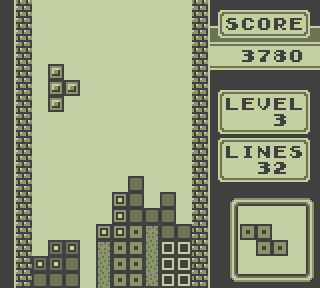
Tetris has a troubled history. Private enterprise was discouraged in the USSR, so when Soviet Academy of Sciences engineer Alexey Pajitnov designed his first Tetris prototype in 1984, he didn't see any profits at all for years. The game was pirated and spread around Moscow and throughout Eastern Europe, where it was discovered by a British software house.

When they had trouble securing the rights to the game, the British company simply released Tetris on their own. Pajitnov himself didn't see any royalties for Tetris until he moved to the United States in the '90s and founded The Tetris Company.

Arguably the most influential version of the game was Tetris for Nintendo's new handheld system, the Game Boy. It was a pack-in title for the system when it launched in 1989. While every Nintendo console up to that point had launched with a Mario game, they switched it up with the Game Boy. It was a simple, pick-up-and-play title that people could enjoy for short periods of time--perfect for a portable system.

"FROM RUSSIA WITH FUN!"
Because of its simplicity and its "easy to learn, difficult to master" formula, Tetris on the Game Boy was also one of the first big casual gaming successes. It brought in a lot of people daunted by gaming up to that point. And it took a fair amount of coercing from the game's publisher Henk Rogers to convince Nintendo to include Tetris with the Game Boy instead of Super Mario Land. Rogers is quoted as telling Nintendo of America that if they wanted to sell the Game Boy to little boys, package it with Mario, but if they wanted to sell it to everyone else, they should package it with Tetris. Nintendo went with the latter.

Tetris was an introduction to video games for millions of people. And seeing that it's currently available on every single console and platform, from the Xbox 360 to old-fashioned cell phones, it's clear Pajitnov's classic puzzle formula remains relevant to this day.

Monday, November 5, 2012

The World's Best Museum is in St. Louis: What the City Museum teaches us about game design


Last weekend my girlfriend had to make the four-hour drive from Kansas City to St. Louis for a graduate class. I'd never been to St. Louis, so I tagged along. I had a whole day to wander this foreign city alone and I'd heard friends mention St. Louis' City Museum, so I stumbled in on a whim. I didn't really know what it was.


Suffice to say, it was the greatest museum experience of my life--and I'm from Washington, DC, the Mecca of American museums. In St. Louis of all places! It boggles my mind why the City Museum isn't famous worldwide, let alone outside St. Louis.

Megami Tensei Retrospective: Persona 4

The Megami Tensei series is one of the longest-running JRPG franchises in the history of video games, yet until very recently it was almost unknown among Western audiences.  As a JRPG hipster I've played most of the modern games, but unlike a JRPG hipster I want as many people as possible to play them.  To encourage this, I'll do a retrospective of recent games in the MegaTen franchise, in reverse chronological order.

Series Overview


To begin with, I thought it prudent to mention properties that almost all games in the series have in common.  There are exceptions, and I'll mention them when it's relevant.  MegaTen is a truly massive franchise, with multiple side stories that have become franchises themselves.  Despite this, they are all descended from dungeon crawlers, being some of the unconditional titles in that genre.  To begin with, the games are time sinks, typically taking between 60-80 hours to complete the basic story.  Very difficult turn-based combat is the mechanic of choice, and the MegaTen franchise was one of the first to have a mechanic popularized by Pokémon: the ability to convince enemies to join your party and fight for you.  In addition, you can also fuse these demons (it's usually demons, but even when it's not the fusion mechanic is still there).  Fusion is vital, as you can't recruit all enemies and the skills you've grafted to your new demon may not be learned normally.  The stories of MegaTen games are also significantly darker than the stereotype of the happy-go-lucky JRPGS, often featuring apocalyptic or post-apocalyptic settings.  With all that said, let's get to the games!


Persona 4: The Popular, Mainstream One


This game is very yellow, color-wise
This is the one most people have heard of, if they've heard of it at all.  Persona 4 is incredibly popular in America and Japan, with huge merchandising, and animated adaptation, a updated re-release for the PS Vita (Persona 4: The Golden), and a spin-off fighting game bridging the stories of Persona 3 and Persona 4 (Person 4: Arena).  The story focusing on the unnamed main character moving to a small country town in Japan, where a strange fog rolls in to town followed by a serial killer.  The protagonist teams up with his high school friends to solve the mystery, which (due to the protagonist's ridiculous power to climb inside a television) leads them to the Midnight Channel, to fight the dark side of man's collective unconscious.  The story is very character focused, each level being generated by the dark side of whatever particular character is trapped in the Midnight Channel.  This brings a lot of character development to the game, while the murder mystery overplot is well paced and gives you a constant goal to focus on.

Global Gaming Spotlight: Minecraft (Sweden)


With each post in this mini-feature, I highlight a game from a different country around the world. Keep in mind these aren't necessarily the best or most popular games from each nation, but simply a fitting representative.

Although it took a few decades to truly emerge as a powerhouse, the Nordic region has been perhaps the most important in Europe over the past ten years. And Sweden leads the way. From EA DICE's shooter stalwart Battlefield and innovative Mirror's Edge to Frictional Games' horror classic Amnesia to Jonatan Söderström's just-released drug story Hotline Miami, Sweden holds its own against any other gaming nation today.

Minecraft - Mojang, 2009

But one name stands out above the rest. Released by Markus Persson's small Stockholm-based studio Mojang as an alpha in 2009, Minecraft has gone on to change the way we look at independent games, and games in general.

Is it even a game? Some have argued Minecraft is simply Lego bricks in videogame form (which became even more meta when a Minecraft Lego set was released this year), a construction toolset that gives players the ability to create what they want. There are no traditional goals or objectives in Minecraft. You can't "win" or "lose." Even the game world of Minecraft is a procedurally-generated random landscape for players to explore. Any of the epic Minecraft creations you see online were created from scratch by players.

Minecraft is really about the players. While you have to figure everything out for yourself, there's a way to make basically anything you can imagine. It was a shakeup for the game industry that recently topped Call of Duty and FIFA as the most-played game on Xbox Live. All in a day's work for Sweden.

Sunday, November 4, 2012

The Factors of Nintendo of America's Marketing Failure (As Shown on the New Wii U Commercial)


      I was a really late bloomer as a gamer. It wouldn't be uncommon to hear about a 5-year-old obtaining all 121 stars in any 3D Mario platformer, or an 8-year-old being one of the dozens of people in line for the release of the next Call of Duty. It wasn't until I was 12, late in the N64 and PS1 lifecycle when I became relatively interested in the unity of various Nintendo franchises celebrating their fame and legacy by beating each other to a pulp. What could have given me that spontaneous moment of interest? Nothing else but this famed and cherished commercial. 


  With a clever choice in music and a hilarious live-action premise, my attention was drawn into Super Smash Bros. This commercial followed a formula: showing something that is memorable and not too vague. Following the N64, the GameCube had hits and a few misses. When a good commercial came on in promotion for a GameCube title though, it not only followed suit, but even exceeded at times compared to the N64 ads. Pikmin 2 was a great example of how Nintendo of America's marketing team can develop a gem.

Global Gaming Spotlight: Grand Theft Auto (United Kingdom)


With each post in this mini-feature, I highlight a game from a different country around the world. Keep in mind these aren't necessarily the best or most popular games from each nation, but simply a fitting representative. After tackling the two cardinal nations of gaming, the United States and Japan, tonight we visit another corner of the game design globe: the United Kingdom.

Grand Theft Auto - DMA Design (now Rockstar Games), 1997

While Europe lagged behind a little when it came to establishing a games industry, Britain was the trailblazer of the continent. Early games from the UK had a penchant for surreal, like Jeff Minter's 1983 classic Attack of the Mutant Camels and Mel Croucher's 1984 not-quite-game Deus Ex Machina.

I could've also gone with one of the other gaming icons of Britain: Tomb Raider. But in the past decade, no UK developer or publisher has made as much of an impact as Rockstar and their Grand Theft Auto series. With humble beginnings in Edinburgh, Scotland--and a résumé that also includes the classic series Lemmings--the company has gone on to become one of the pioneers of gaming today.


The series' move to 3D with Grand Theft Auto III was the first huge success of the post-September 11th era, and sparked controversy with its recklessness and violent fun. GTA: San Andreas took the game to the next level with its gigantic open world. And Grand Theft Auto IV took the franchise into the next generation of gaming.

But I had to pick the original 1997 Grand Theft Auto, when the company was still a tiny studio. It was a hint of what was to come with British gaming, and its two London expansion packs are still the franchise's only visit to the series' home country. It bummed me out to discover the upcoming Grand Theft Auto V will take place in faux-Los Angeles. This is well-traveled territory for GTA; when will they give up the American obsession and explore Britain again?

Saturday, November 3, 2012

Global Gaming Spotlight: Tokyo Jungle (Japan)

With each post in this mini-feature, I highlight a game from a different country around the world. Keep in mind these aren't necessarily the best or most popular games from each nation, but simply a fitting representative. After beginning with my native United States yesterday, we head to the other colossus of the gaming world today: Japan.

Tokyo Jungle - Sony, 2012

Of course, there are thousands of Japanese games to choose from. But while many Japanese games take place in fictional worlds or even in America, I wanted a game that takes place in Japan.

Tokyo Jungle took the world by storm this year. Taking place in a future version of the Japanese capital where humans are gone and animals must duke it out, Tokyo Jungle takes a very Darwinian approach to the survival genre.

The game was a hit in its home country, and later became a cult success in the West, despite its decidedly-Japanese weirdness. In an era where many people think the Japanese game industry is faltering internationally, Tokyo Jungle makes no concessions to try to appeal to global audiences.


Producer Masaaki Yamagiwa recently told Gamasutra:
"Users from other regions and Japanese users have different perspectives to begin with, so it's not surprising to see the gaps between what they think is fun versus what we think is fun. Japanese people should be 'Japanese' and simply create what they think is fun, and have other regions accept it as a novelty item."
Hopefully this is inspiration to other Japanese studios to really flex their creative muscle, instead of trying to please Westerners with more big-budget flops like Resident Evil 6.

Friday, November 2, 2012

Global Gaming Spotlight: Fallout 3 (United States)


A motif has popped up in my writing lately--comparing game cultures of different countries. So I've decided to begin a recurring mini-feature on the site: Global Gaming Spotlight. I'll highlight a game from a different country in each article. It won't necessarily be the best or the most popular game from a given country; it'll simply be the one I find most representative of that nation, or the first one that comes to mind when I think of that country.

I firmly believe the game design landscape must expand beyond simply the United States and Japan, so I'll use short blog posts to highlight games from countries you wouldn't quite expect--or games you already know, but didn't realize was made in Bulgaria or Brazil.

Without further ado, I begin the Global Gaming Spotlight in my home country: the United States.

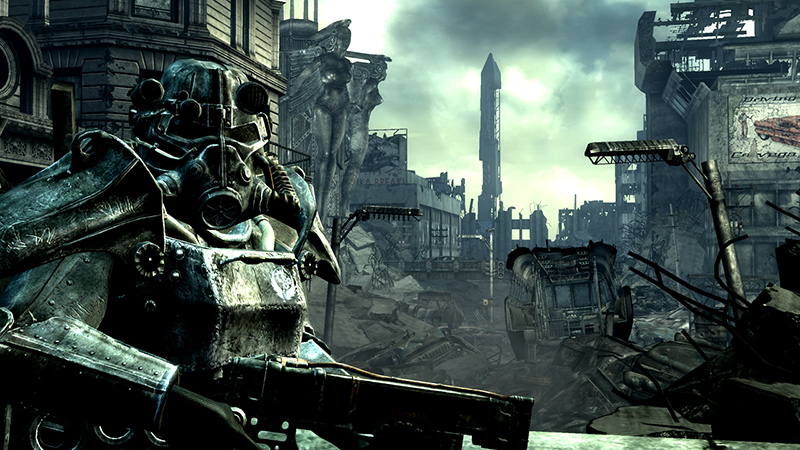
Fallout 3 - Bethesda Game Studios, 2008

The list will get more interesting when I get to more obscure countries, but I can't forget the game development giants. Of course, there are thousands of American games to choose from. I thought about choosing an über-AMERICA game like Duke Nukem or Madden to represent the good ol' U.S. of A, but in my heart I knew I had to pick Fallout 3.

The 2008 open-world masterpiece is set in the nation's capital and my hometown of Washington, D.C. It was designed by Bethesda Game Studios, founded in nearby Bethesda, Maryland, and headquartered in Rockville. And of course, this website gets its name from Fallout 3's post-apocalyptic wasteland.


Fun fact: a big part of navigating D.C. in the game is traversing the ruined subway system. So leading up to Fallout 3's release, big ads for the game were posted in multiple Metro stations around real-world Washington. This caused a controversy, though, as some riders found it distressing to see pictures of their home city demolished on their commute to work.

Fallout is a commentary on very American themes. It's set in a Jetsons-style 1960s vision of the future, which has then been destroyed by nuclear holocaust. The fears of communist China don't seem to matter anymore when everything is blown up. But the few remaining survivors in the Capital Wasteland must reconcile their lingering values of American exceptionalism and individualism to live together in what's left of the country. After the world's governments are no more and the veneer of the nation-state is removed, how do we form a communal identity?

Wednesday, October 31, 2012

Creepiest Game Ever: Pokémon and Lavender Town Syndrome

I spent a lot of time contemplating what to write about for Halloween. Top ten horror games? Nah, that's well-trod territory--plenty's already been written about Silent Hill 2 and Amnesia: The Dark Descent. The best Halloween-themed games? Really, Costume Quest is all you need. Then I was reminded of one of the creepiest passages in a video game I ever played as a child: Lavender Town in Pokémon Red Version.

The Pokémon series has a history of morbid touches beneath its "cute" exterior. There's Cubone, a Pokémon who wears the skull of its dead mother, and Yamask, who carries around a mask of its face when it used to be human. But my favorite is Lavender Town, the main graveyard of the Pokémon world.

It's where the player encounters ghost Pokémon... and incredibly creepy soundtrack:


This song, composed by Junichi Masuda, was rumored to be the cause of hundreds of child suicides across Japan shortly after the original Pokémon games were released in 1996, known as "Lavender Town Syndrome" or "Lavender Town Tone." This was apparently due to a high-frequency sound in the song that could only be heard by undeveloped ears--hence why it was only happening to kids. This sound drove the children to kill themselves. It was quickly changed by Nintendo for the game's worldwide release, so the only place the sound can be found today is in the original Japanese Red and Green versions of Pokémon.

Whether the story is true or not is questionable. Either way, it's one of the freakiest songs ever featured in a children's video game.

Tuesday, October 30, 2012

Why aren't there more Korean video games?


By this point, we all know what a big deal South Korea is in the gaming community. From StarCraft to League of Legends to Counter-Strike, Koreans dominate the competitive gaming world. But why don't we see more video games developed by Koreans?

Of course, there are a fair number of games made in Korea. The country has a very PC-centric gaming culture, so most of these are online PC games. But the majority are aimed at the domestic Korean market. Korea's biggest international hits are almost all massively-multiplayer online role-playing games, like Wizet's MapleStory and NCSoft's Lineage and Aion. The popular MMORPG Guild Wars, while developed by American studio ArenaNet, was published by NCSoft as well. Another Korean MMO, Gravity Co.'s Ragnarok Online, was a flop in the West, but a huge hit across Asia. Many of these Korean online games pioneered the free-to-play business model that's so trendy worldwide today.

But considering what a huge gaming consumer market it is, these Korean games are a mere blip on the radar. It's a country of 50 million people and a GDP per capita of $32,000. It's also the most internet-connected country in the world, due to government programs aimed at establishing nationwide networks. So why haven't we seen a true Korean international blockbuster?

Let's look at Canada, another "developed nation close to a much bigger gaming powerhouse." Today, Canada's games industry is thriving. Vancouver and Montréal are hotbeds of game development. A big part of this is because many of the biggest Canadian developers are owned by foreign publishers. American gaming juggernaut Electronic Arts alone has either opened or bought a huge percentage of Canada's major game studios.

What about South Korea? Japan is only a stone's throw away, yet Japanese publishers have been incredibly reluctant to open up shop in Korea. Why is this?

You don't need to take an Asian history class to know Japan and Korea aren't quite fond of one another. The reason Koreans love PC gaming over consoles in the first place is because many Japanese game consoles weren't even sold in Korea. This culture clash may be at the heart of the Korean games industry's problems. And it's why, while Japanese gamers have hesitated to embrace Western genres like real-time strategy and first-person shooters, Korea loves StarCraft and Counter-Strike.

With South Korea a rising star on the global stage, we'll likely see a few more games from them in the future. But they need to get a little more friendly with their neighbors to the east if they want to become an international player in the game world.

Monday, October 29, 2012

Yoot Saito and Seaman: Analysis of one of the best interviews... ever.

[Note from Jake: our writing staff expands ever further, with the addition of Alex Metcalf!]

Extreme Close-Up Courtesy of GamesTM.co/uk

   October 15th of this year marked the 50th birthday of one of the most peculiar and arguably one of the least business-friendly designers in the video game business.

   Yoot Saito gained his reputation when he created Seaman for the Sega Dreamcast. The game was best described as a pet simulator; your pet grows, develops, and interaction is much encouraged. The key factor, though, is that your pet happens to be a mutant talking fish that features a human face and a weird phallic appendage attached to its forehead. The player interacts with this creature via a cheesy-looking microphone attachment for the Dreamcast controller. Seaman has the ability to recognize spoken words with the microphone—almost any spoken word stimulates a specific voice-over response from the mutant fish to promote intuitive interaction. This game was released in 1999, so the technology at the time was rather impressive.

   That premise in itself is one reason why this game bombed pretty hard in its initial sales in both Japan and the United States. The other reason was that it was on the Sega Dreamcast—the only major gaming console since 1998 not to have exceeded a 3-year lifespan. Even though sales seemed demeaning in its early process, attention for the game roused up gradually, especially in Japan.

And besides, how can anyone not love a face like this?

   In 2006, the slowest year in the Nintendo GameCube's lifespan, Yoot Saito released his next long-awaited project, Odama, on the system. Odama was a breed of pinball gameplay and tactical wargaming in the setting of Japan in its feudal period. With another silly premise and its release on a dying console, does Yoot Saito carry some case of a fetish for these two aspects?

Survival Horror: An Elusive Genre

[Note from Jake: Just in time for Halloween, I introduce the newest addition to my staff, Adam Frost!]

It's 1999, and I'm in 3rd grade. I have invited a couple of my best friends to my house for a sleepover. It's late. We turn off all the lights, insert the Resident Evil 2 cartridge (blowing on it first, to make sure it works) and fire up the N64. Let the pants-shitting commence.

Everyone has these memories, be it a scary game, a horror film, or even a scary book or story. For me, this is when my affinity for survival horror games began. There are few things more exhilarating than exploring a well-crafted world, adrenalin pumping, knowing that something terrifying may be waiting for you around every corner.

With the release of Resident Evil 6 many reviewers (who hadn't already done so) are lamenting the death of this once-great horror series that seems to have lost its way.  Indeed, starting with Resident Evil 5 or perhaps even with RE4, the trend has been one of moving away from horror towards action.  With this in mind, now is as good a time as any to discuss what makes a good survival horror game, and why it seems that so many games get it wrong.  To do this, I will use the examples of Resident Evil 4 and Dead Space.

The most important component to any good survival horror game is atmosphere. Through the use of sound, music, and setting, a good survival horror game lets the player know that they are in a dangerous, terrifying, and even hopeless environment. Be it a creepy village in the middle of rural Spain (RE4), or the abandoned wreckage of the spaceship Ishimura (Dead Space), the setting of a horror game can make or break its scariness.  In the case of Dead Space, the setting is arguably one of the more terrifying aspects of the game. Trapped on a massive abandoned spacecraft light years away from potential rescue, the player knows that there is little hope for survival. On the other hand, walking around in broad daylight under the hot African sun in RE5 does not create a sense of terror or mystery for the player.


Sound is another important aspect in creating a good horror atmosphere. The right sounds can send chills down the player's spine as they explore the game world. In RE4, the creepy whispers and shouts of los Illuminados, a cult of mind-control-parasite-infested Spaniards, let the player know that an enemy can and will cause you to soil yourself at any moment (spoiled only if the players know Spanish).