Showing posts with label survival horror. Show all posts

Thursday, January 30, 2014

New Classic Gaming: the Fatal Frame series.

I'm happy with my haunted house-fit.
A modern classic series I’d always been interested in, but for whatever reason never taken the plunge and played through, is Fatal Frame. I finally decided to this past week. I ended up playing Fatal Frame and Fatal Frame 2: Crimson Butterfly via PlayStation Network, and 零: 眞紅の蝶 (ZERO: Deep Crimson Butterfly), the Japan-only Wii remake of the second game. I own Fatal Frame 3: The Tormented, but I have yet to set up my PS2 and take it for a spin.

Horror games, like horror movies, walk a fine line between scary and ridiculous. Ultimately the situations are stupid and unrealistic, so the game has to elevate itself to such a level that it either transcends the inherent mediocrity, or owns up to the silliness of the whole thing to make it an enjoyable experience. Fatal Frame does the former.
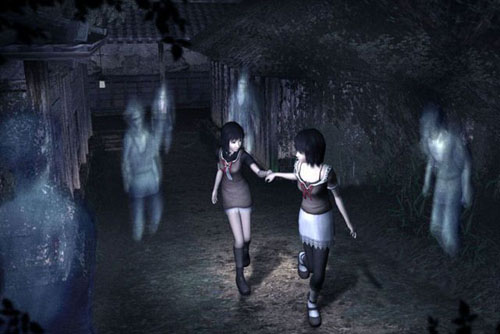
This girl does not do escorts.
It takes a Silent Hill approach in that its strength is in its atmosphere. You might argue the narrative is SH’s real strength, and I don’t disagree (certainly in regard to SH2), but no other game has used atmosphere as well as SH has, except perhaps FF. The first game is a haunted house and the second takes place in a haunted village.

The house is everything you’d expect with a dimly lit, decrepit looking why-the-hell-would-anyone-ever-decorate-a-room-this-way aesthetic with many inexplicably locked doors (though, as a rare exception to the rule, every single door does eventually open in FF1, unlike the forever closedness of much of SH), each of which require a ridiculous, themed key. So judging by the precedent set by Resident Evil, standard fare.

The town in the second game is as quiet as it is creepy, and its small size lends a claustrophobic air to everything. In fact, I think it feels more claustrophobic in Fatal Frame 2 than in the haunted house of the first game. The town is traditional Japanese, which means you have houses very close together with little space in between to travel, which makes it feel as if you’re just in a wide hallway when you walk outside. And it’s here that you find yourself armed with only a camera, cornered by ghosts.

Small hallway, weird controls, creepy-ass twins... check.
Battles are frequently tense due to the small space you have to use while your camera for nearly the entire game is much too weak for the circumstances. Like Final Fantasy XIII, normal and even weak ghost fights take two or three times as long to finish than they should, and due to your character being a mid-teens girl, you don’t have much resistance or speed against these attacks. You frequently get hit and sometimes even these normal ghosts can take half of your health with one hit. Sure, it adds to the overall sense of desperation and forces you to evolve your strategy to account for chronic low health, but goddamn is it infuriating sometimes.

And that brings me to my next point: appalling controls. Sometimes. The first game is bad. Nigh unplayable at times, actually. In battle, I mean. Moving and item collection/usage is standard across the games, even if the purpose of the spirit stones is absolutely impossible to discern in the first game. But besides collecting all those damn things and not understanding exactly why, the biggest problem is with the first person perspective camera controls. As soon as you bring out the camera and begin aiming, the left stick controls the view, and the right stick moves your character. That’s right: for some idiot reason, the designers thought it made sense to reverse the analog sticks when you go into battle mode, where reflexes and memorized controls exist to keep you from doing these kind of mental gymnastics and allow you to succeed. During the many boss battles, the controls become a serious handicap as your natural sense of moving with the left stick and looking with the right stick, as in every other game ever, is forcibly curtailed into this totally unintuitive scheme. And as such, the game becomes very difficult, and you exhaust your health, and film, supplies and become very frustrated.

Recent selfie.
FF2 on PS2 addresses and fixes that problem and keeps a uniform scheme no matter what view you’re employing, but the Wii remake adds all new control issues. Thankfully, it's not so much a matter of intuition as it is just a completely different experience. As it uses the Wiimote, it expects you to be a good soldier and constantly hold the controller at ready position, which keeps your flashlight level and your character steady. But if you let your hand move slightly or drop for a rest against your leg, depending on what you're doing, it can spell total disaster. In ghost encounters, you control your movement and your left-to-right looking with the nunchuck, but you control your camera and your up-and-down movement with the Wiimote, so you're kinda back to the original weird problem from FF1 where your controls, which had been controlled all on one hand, are now split across both hands, and it's not incredibly intuitive as to which hand does what. My real problem, however, is the inability to delegate the controls manually. I hate that I am forced to use broken controls. 

As I said, however, the PS2 control scheme was fixed for FF2, but now it’s other things that make the game difficult to play, like an unnecessary pause between coming out of picture mode and being able to move, and no chance of strafing when some of these ridiculously fast ghosts come at you. But that’s game design, not controls, anymore. Really, the rest of the problems I have with this series as a whole come down to nit-picky frustrations when I’ve made a mistake or not properly conserved film and am down to the least powerful film, which is about as effective as a Q-Tip against a meteor.

Q-tip and a meteor?

But it’s excellent. It’s creepy, and beautiful, and interesting. And it is absolutely the franchise I want to come out next for Wii U. If ever the Wii U’s controller was perfect for any game, where your weapon is an exorcismal point and click camera, this one is it.

Monday, October 29, 2012

Survival Horror: An Elusive Genre

[Note from Jake: Just in time for Halloween, I introduce the newest addition to my staff, Adam Frost!]

It's 1999, and I'm in 3rd grade. I have invited a couple of my best friends to my house for a sleepover. It's late. We turn off all the lights, insert the Resident Evil 2 cartridge (blowing on it first, to make sure it works) and fire up the N64. Let the pants-shitting commence.

Everyone has these memories, be it a scary game, a horror film, or even a scary book or story. For me, this is when my affinity for survival horror games began. There are few things more exhilarating than exploring a well-crafted world, adrenalin pumping, knowing that something terrifying may be waiting for you around every corner.

With the release of Resident Evil 6 many reviewers (who hadn't already done so) are lamenting the death of this once-great horror series that seems to have lost its way.  Indeed, starting with Resident Evil 5 or perhaps even with RE4, the trend has been one of moving away from horror towards action.  With this in mind, now is as good a time as any to discuss what makes a good survival horror game, and why it seems that so many games get it wrong.  To do this, I will use the examples of Resident Evil 4 and Dead Space.

The most important component to any good survival horror game is atmosphere. Through the use of sound, music, and setting, a good survival horror game lets the player know that they are in a dangerous, terrifying, and even hopeless environment. Be it a creepy village in the middle of rural Spain (RE4), or the abandoned wreckage of the spaceship Ishimura (Dead Space), the setting of a horror game can make or break its scariness.  In the case of Dead Space, the setting is arguably one of the more terrifying aspects of the game. Trapped on a massive abandoned spacecraft light years away from potential rescue, the player knows that there is little hope for survival. On the other hand, walking around in broad daylight under the hot African sun in RE5 does not create a sense of terror or mystery for the player.


Sound is another important aspect in creating a good horror atmosphere. The right sounds can send chills down the player's spine as they explore the game world. In RE4, the creepy whispers and shouts of los Illuminados, a cult of mind-control-parasite-infested Spaniards, let the player know that an enemy can and will cause you to soil yourself at any moment (spoiled only if the players know Spanish).