Showing posts with label Nintendo. Show all posts

Saturday, February 22, 2014

Super Smash Bros: Nintendo's Undercover PR Machine

You love Super Smash Bros. I love Super Smash Bros. Even people who don't like video games love Super Smash Bros! Everyone loves seeing their favorite Italian plumber and pointy-eared adventurer duke it out. But it's not just the big names like Mario and Link in SSB. The first time many of us played the game, we had no idea who Ness or Captain Falcon were. Heck, some first-time SSB players back when the original was released in 1999 didn't even know Samus was a chick. But those characters have earned a place in our hearts, and their games have gone on to become popular in their own right.


When EarthBound was finally released on the Wii U Virtual Console last year, it was a huge deal. Some of it was due to the game's cult status, but most people rejoicing had never touched the game before. Most players' familiarity with the game and its characters comes from Super Smash Bros. Nintendo, master of nostalgia, has this sneaky way of using Super Smash Bros. to make us nostalgic for games we never even played.

Super Smash Bros. hooks us in with its big-name characters, but it uses the game to introduce the company's more obscure and dormant series. Fire Emblem had never seen a Western release before Marth and Roy showed up in Super Smash Bros. Melee, but once the characters found a devoted fanbase in Melee, suddenly we got a whole slew of Fire Emblem titles released outside Japan. There hadn't been a new Kid Icarus game in over two decades, but once its protagonist Pit appeared in Super Smash Bros. Brawl, his popularity prompted Nintendo to create Kid Icarus: Uprising for the 3DS in 2012.


Super Smash Bros. is, along with Mario Kart, by far the most commercially successful crossover Nintendo franchise. It appeals to both hardcore gamers and the casual crowd. It's a love letter to Nintendo games, with its trophies and extras effectively serving as a Nintendo encyclopedia. But in many ways, Super Smash Bros. is simply a marketing vehicle for Nintendo's B- and C-list franchises. That's not a bad thing. Tons of creative new games have come to fruition due to characters' popularity garnered in SSB.

We're all dying to learn which characters will join the lineup of the upcoming Super Smash Bros. for 3DS and Wii U. I'm excited for the game itself, but I'm even more excited about what the new SSB lineup means for Nintendo's lesser-known series. Little Mac from Punch-Out!! has already been revealed; what other characters from less famous series would you like to see in the new Super Smash Bros?

Tuesday, January 28, 2014

Revisiting the legacy of Metroid II: Return of Samus

I've already written extensively about Metroid, Nintendo's black sheepMetroid II: Return of Samus, released in 1991 on the Game Boy, is the black sheep of the black sheep series. Even among Metroid fans it's often overlooked, as most Game Boy games are. But Metroid II is as pivotal in shaping the series as the original Metroid and the opus Super Metroid. This oft-forgotten sequel is fascinating to explore as a statement of design philosophy.


Let's begin with the title. Metroid II. Most handheld iterations of major series are marketed as spinoffs, rather than true sequels. The Mario games on the Game Boy were called Super Mario Land to differentiate them as inferior to the larger Super Mario WORLD on the big-boy Super Nintendo. The portable version of Assassin's Creed III was given the "Liberation" subtitle to make sure people knew it wasn't the REAL Assassin's Creed III, which could only be found on home consoles.

But Metroid on the Game Boy was simply called Metroid II. It's no coincidence Metroid creator Gunpei Yokoi was also the creator of the Game Boy. Metroid II was proof you could make "real" games on handheld systems, not just spinoffs and puzzle games.

It's not a masterpiece. Due to the limitations of the hardware, Metroid II features bland level design and recycled art assets. Many of the environments look almost identical to one another, which is all the more frustrating since there's no in-game map. And the music, while continuing the atmospheric dissonance pioneered in the original Metroid, is terribly subpar by the series' standards.

It's not a cartridge, it's a Game Pak!

There's so much to digest, though. Metroid II introduced tons of concepts and gameplay mechanics that would go on to become staples of the series, from save stations and Samus' spaceship to items like the Spider Ball and Plasma Beam. The game has an interesting structure, in that there are no conventional boss battles aside from the Queen Metroid at the end.

The series is known for its minimalist storytelling (well, until recently...). For an overlooked Game Boy game, it's strange that Metroid II includes perhaps the most important plot point in the entire series.

The set-up of Metroid II's storyline is questionable. Samus is on a mission to kill every single Metroid on planet SR388. They're not invading or terrorizing anyone else; SR388 is their home planet. Samus is the alien invader, out to commit genocide. There's even a counter at the bottom of the screen telling you at all times how many Metroids are left alive. But at the end of the game, after Samus has killed the last Metroid, she finds a Metroid egg that hatches in front of her. The newborn Metroid imprints onto her and believes Samus is its mother. So she spares the infant and takes it with her at the end of the game.

This has massive implications for the rest of the series. It immediately sets up the story of Super Metroid, where the Space Pirates steal the baby Metroid, and the dramatic ending where the baby Metroid sacrifices its own life to save Samus. It also evolves Samus' relationship with Metroids from a simple antagonistic one to a more ambiguous symbiotic connection, which would be further explored in Metroid Fusion.


The Mother Factor is particularly interesting. Not only was Samus the first major female protagonist in video games (Ms. Pac-Man doesn't really count--she's Pac-Man with a pink bow, not a human), but the main villains in Metroid and Metroid II are both female as well: Mother Brain and the Queen Metroid, respectively. Mother Brain would make a reappearance as the antagonist of Super Metroid.

How many other video games feature both a female protagonist and antagonist? And neither of them are objectified or sexualized for the Male Gaze, either? It's really just Metroid… and Portal.

Metroid II was originally planned to get a colorized remake for the Game Boy Color like The Legend of Zelda: Link's Awakening got with Link's Awakening DX. But Metroid is not the same cash cow for Nintendo that Zelda is, so it never happened. Metroid Prime developers Retro Studios talked about doing a remake of the game like the original Metroid got with Metroid: Zero Mission, but that never panned out either. Metroid II was not re-released in any form until 2011, when it was released on the 3DS Virtual Console.

It's a shame there hasn't been a handheld Metroid game in eight years, or a traditional Metroid sidescroller in ten years. I wouldn't recommend Metroid II to anyone in 2014 aside from diehard Metroid fans, but it's one of the most important, overlooked games Nintendo has ever made.

Thursday, January 23, 2014

Console review: Wii U


The "next generation" of game consoles is in full swing now, but while I wait for the PlayStation 4 and Xbox One to gain decent libraries, I've just purchased Nintendo's Wii U. It's been called a commercial failure.

But with an affordable price point much lower than the competition and a growing library of great games like Pikmin 3, The Legend of Zelda: The Wind Waker HD, and Super Mario 3D World (along with Virtual Console classics like EarthBound), the Wii U has become a must-have.

The box


One of Nintendo's biggest issues selling the Wii U to mainstream audiences is making people realize it's actually a new console, not just an accessory for the Wii. Part of that is due to the look of the console itself. It's so sleek and compact, it's almost too sleek and compact for its own good. The Wii U GamePad is front and center in all Nintendo's marketing, and the console itself gets lost in the shuffle. To the casual observer it could just look like a fancy external hard drive or wireless router.

It's a beautiful, minimalist design, in stark contrast to Sony and Microsoft's hulking goliaths of gaming boxes. It's about the same size as the original Wii, but with a more rounded, less angular design. Considering how compact it is, I was pleasantly surprised to find the Wii U still has four USB ports, along with the SD card port. And it runs more quietly than any other disc-based console I've ever played.

The GamePad


It looks wonky at first glance. How are you supposed to play regular games on this controller? But then you lay your hands on it. The dual analog sticks are silky smooth, less oversized and cumbersome than PlayStation sticks and better made than cheap rubbery Xbox sticks. I was worried the buttons would be clicky like the 3DS', but they're like knives through creamy butter. The D-pad is perhaps my favorite D-pad of all time.

The PlayStation features analog sticks that both sit below the face buttons. The Xbox features an asymmetrical design, with the right analog stick below the face buttons and the left analog stick above them. Nintendo completes the cycle, with a controller featuring both analog sticks above the face buttons. I was worried it'd be awkward to press the face buttons with this layout, but it works perfectly. With your thumbs on the analog sticks, the middles of your thumbs rest comfortably near the buttons.


A major reason the GamePad avoids being awkward for conventional gaming is the back of the controller, which is ergonomically contoured to feel like any other traditional game controller. And despite its size, the GamePad is surprisingly lightweight.

Speaking of traditional controllers, Nintendo also sells the "pro" controller for multiplayer and for people who want a more standard experience. It's the exact same button layout as the GamePad, minus the screen.

The pro controller's shape is similar to an Xbox controller, although it's slightly wider and more lightweight.

But the GamePad is really the star of the show. Its touch screen is used for secondary game functions, like the touch screen on the DS and 3DS. Showing your map, inventory, and menus while the TV screen shows the real gameplay. You can even use the GamePad to control your TV and your cable box.

Off-TV play

Nintendo hasn't done a very good job of marketing the Wii U GamePad's greatest function, though: off-TV play. You can turn off your TV and play games through the GamePad alone. This works great if you want to play in bed or in the kitchen or anywhere else in your house outside the living room. Or if someone else wants to watch TV and you still want to play games. The GamePad even features its own speaker, volume adjuster, and headphone jack. 

Many people have complained this comes at the expense of the GamePad's battery life, which only lasts five hours. I haven't yet played for five straight hours without charging, though, so it hasn't come up as an issue for me.

Besides, you can play the GamePad while it's charging, and since it uses its own AC adapter separate from the Wii U console, if you really want to you can charge the GamePad in your bedroom and play while the console remains in your living room. It's a non-issue.

The Pro Controller simply charges using a standard USB cable, like the PlayStation controller. It has an 80-hour battery life.

The only downside

Everything about the Wii U design is perfect, except for one thing: the controller's trigger names. The triggers themselves are great. But while the shoulder buttons are called L and R, the triggers are called... ZL and ZR. What sort of button names are those?!

Nintendo has a strange history with triggers.

The legendary Nintendo 64 trigger was the Z button.

The GameCube featured the buttery smooth analog/digital L and R triggers, and an awkwardly-placed Z button.

The Wii remote's trigger was the B button, which was hard to get used to. The Nunchuk's trigger was the Z button, and its shoulder button was the C button. Unusual naming convention.

And now with Wii U, we have L and R for the shoulder buttons, and ZL and ZR for the triggers. When the button is displayed onscreen in a game, I feel like I'm meant to press two buttons.

Why couldn't Nintendo have just taken a page from the competition's book on this? PlayStation controllers have L1/R1/L2/R2, and Xbox controllers have L/R/LB/RB. These both make much more sense than L/R/ZL/ZR.

But aside from that: the Wii U design is perfect.

Sunday, January 19, 2014

Nintendo's Future, Re-opinioned

One of the things I kept coming back to in Jake’s and my argument about the future of videogames is that I just don’t see the future being too terribly different from the present. In other words, I don’t think that the technological singularity is going to happen as quickly as Jake is afraid it’s going to. I do think it will happen, but not soon.

In our “discussion,” I referenced the incomparable Mr. Stephen Fry and his BBC radio show “Fry’s English Delight,” specifically the episode about the future of the English language as compared to today. I brought up one particular point made by one of the guests on the show about how, obviously, it is impossible to predict the future (hell, the singularity could happen tomorrow, or next month, or next year), but you can make predictions based upon precedent, specifically, how things have happened in the past. In the show, Fry posited the question about whether in, say, 200 years, the English language would be, to contemporary speakers and readers, completely indecipherable or not. The answer was a definitive “no.”

What the f...?
And here’s why: the only thing we have to go on is history, and, looking back at the history of the English language, we can go back much farther than only 200 years, in fact. We can go all the way to Shakespeare or Chaucer and still understand their English, albeit with some difficulty, especially with archaic words and word spellings and meanings. If we can understand them, it’s likely that we will be able to understand our future language, albeit with difficulty. There’s more to it, but that’s the relevant idea. We should be able to understand and get along. And I think that is directly applicable to the future of video game consoles.

Again, it’s my opinion that the technological black hole will happen, I’d be shocked if it didn’t, but I don’t think it will be as quick as it’s feared. And the reason why is both the past, and people.

People don’t change much, all considered. Look at the older generation: how many of them play video games? Very few, I’d wager. Is it because they just don’t understand all these new-fangled gadgets, or is it because they don’t understand why kids these days can’t just go outside and play, or is it because they’d rather just read a book, or keep a garden, or any other number of excuses they give? Well, yes, exactly. It’s not because they think games are inherently stupid (well, they might, but they’re wrong), it’s because it’s not what they grew up doing. It’s not what they're used to.

"I've been googling 'Jenna' all day, but only
 one of them was my granddaughter."
And we’re all like that. I remember looking at the original Wii, thinking, “man, I just don’t want to be forced to wave my arms to play a game.” And, to a degree, I still feel that way. And, apparently, so does everyone else. Of course, the action games like Wii Sports or Wii Fit that make you flail like a 5 year old still exist, but the casual game that anybody can pick up and play is, more or less, a gimmick. Most gamers, the so-called hardcore crowd, are used to using old-school control schemes, and are thus more comfortable with that kind of setup. The Wii U is a response to that (even if a slightly cumbersome one), and the overall de-focus on wand-waving is evidence as well. Wand-waving is around, but it will never replace classic controls… Until the kids today grow up and become video game company leaders who only want to play games where flailing is a necessity.

But, I’d say, where this is really important, the whole “used-to” factor I mean, is with the Game Boy.

Portable gaming has come a long way. A long, long way. Portable gaming is everywhere from Apple and Android devices to popular Nintendo and Sony handhelds to little 3rd party screens that play Pong and other older games, usually sidescrollers like Contra­ or 1942. Jake thinks – fears – that portable gaming will be taken over completely by the iDevices and that the Game Boy (and DS, and 3DS) as we know it will cease to exist. This is where we completely disagree.

It doesn't look 30.
Did you know that the Game Boy has been around nearly 30 years? Good god, that’s a long time for a gadget to live. Granted, they’re not all the same, we’re talking Game Boys, GB Colors, GB Advances, DSes, and now 3DSes, but the fact remains that, despite the upgrades, it’s the same device that serves the same purpose: portable video games. The demand for which has not only not decreased, but has remained so outstandingly popular that every kid everywhere ever wants or has at one point wanted one, especially in 2013 (supported by factual basis). Kids, known for being fickle bastards, have remained loyal to Nintendo for all these years, and Nintendo kids like Jake grew up and continue to be loyal even as adults. Regardless of how amazing and powerful new cell phones and tablets will continue to become (and what emulators they employ), they simply don’t replace holding a proper Game Boy and booting up Tetris or Pokémon in the car on a family trip or on the train going to work.

But here’s where it gets tricky: languages are living, breathing entities that change as people change; technology is dictated by the speed of progress, and isn’t dependent on rate of spread. There could very well be a new tech in the next few years that will entirely replace the need for a Game Boy in any sense (a perfect, and I mean perfect cell phone virtual control pad, for instance). But that’s impossible to predict. It might happen, it might not. You could argue cell phones and iPods already have replaced Game Boys, and there’s valid argument, but, as Jake argued and with which I agree, Nintendo’s catalog of games is not to be trifled with, and I don’t see Nintendo giving up its exclusive publishing rights to Mario, Pokémon, Metroid, Donkey Kong, Zelda, etc. If for some reason they ever decide to give up in the proper console war, they’ll be able to focus solely on building their own proprietary Game Boy hardware (and software) and still succeed.

But if they want to win this console war (which they don’t appear too troubled about, honestly), they’ve got to utilize the Virtual Console intelligently. Why is the Wii U cupboard so bare? Why did it take years and years for EarthBound to come to any VC, and then only to one VC? Why in the world are they treating each specific system’s VC as separate and individual? If Nintendo is smart, they’ll take a page out of the PSN manual and merge the VCs together, actually get their shit together in regard to back catalog game releases, and use every single resource at their disposal, namely the Gamecube, N64, and Dreamcast licenses they no doubt have access to. Jake’s mention of getting Shenmue on the VC? That came from me, yo. I would gladly pay for the ability to play Shenmue on a console I still currently own and use (my Dreamcast in my fluent language is across the sea), but I don’t appear to have anywhere to throw my money to make that happen. Why the fuck not, Nintendo?!

Oh, oh, oh, oh, oh. Oh.
Or Sony. Or Microsoft. I’m not pressed.


Previewing Bravely Default: A New Classic

This is the first post by new contributor Danny Westendorff! -Jake

If you play video games these days and have at least half a pulse, you've probably heard of the Final Fantasy series, the JRPG series that put Square-Enix (formerly Squaresoft) on the map and quickly became the face of JRPGs as a whole.


These games typically feature turn-based combat where players control a party of 3-5 characters with varying abilities based on their "class". i.e.- Knights can block hits for their allies, Mages cast magic, Thieves can steal items, et cetera, using strategic combinations of spells and skills to fight monsters, crawl dungeons, and (typically) ultimately save the world from some sort of catastrophe.  I, personally, have always loved these games for their story and have loved them since I first met Final Fantasy IV in 1994 (or so).

Well, the illustrious developing company does more than just churn out a new Final Fantasy every two or so years, and it is on this subject that I would like to speak.  As it turns out, Square-Enix is producing a new game that is coming stateside on February 7th, Bravely Default.  I played the free demo and thought I'd speak my piece on it.
,
But first, I have a short tale I'd like to spin.


I'd like to start this post with a little trip down memory lane, back to 1997 when Final Fantasy VII was released, the game that launched a thousand cosplayers (but this isn't about that).  Final Fantasy VII changed the way players could customize the roles played by each of their characters through the use of Materia.  You could give your characters nothing but magic, all commands (steal, throw, etc.), summons out the yin-yang, or a sensible combination.  It was cool, innovative, and a fun break from the "Ninjas-have-throw, Thieves-have-steal" formula from the past.

Time marches on, and 1999 rolls around, bringing with it the release of Final Fantasy VIII and its Junctioning system, where characters gain different stats, abilities, and skills based on which Guardian Forces (summons) they have linked with them.  Again, it was a clever way to change up the system, allowing you to customize your character.  Maybe you'll give your main bruiser the "mug" ability, letting you attack and steal simultaneously, you get the idea.

But then Final Fantasy IX comes out in 2000 (the last to be released on the PSX), with a refreshing return to the class-based Final Fantasy that we all fell in love with. Your Thief came preloaded with the steal command, and so on.  In fact, the Black Mage character was modeled after the original design and there's even a bit in the beginning where your White Mage/Summoner disguises herself in the traditional White Mage robe.


See what I mean?
I'm sure right about now you're wondering what the point is, and I apologize for the digression.  The point, dear readers, is that while innovation is great, sometimes what we want--what we really need is a brief return to normality.  I sincerely believe Final Fantasy IX was what we needed, when we needed it.

Flash forward to 2012, and we're up to Final Fantasy XIII-2 (actually XIV, but I don't count the MMOs, so sue me).  We've seen the Sphere-grid, braved the License Board, and harrowed the Paradigm System, each one more complex and innovative than the last.  Some people are holding their breath for Final Fantasy Versus XIII, and some are waiting for Type-0 to make its journey to the west.  So what's next for Square-Enix?

Ta-da
In October of 2012 Square-Enix released Bravely Default: Flying Fairy in Japan, a role-playing-game about God-knows-what (I'm not spoiling the plot for myself).  It's 2014 and Bravely Default is finally coming Stateside in February, with a 3DS release that's actually an updated version called Bravely Default: For the Sequel in Japan (who continue to come up with strange subtitles >___>).

Now, I've played the free demo and I am pleased to say that, so far as I can tell, the game is a new-classic Final Fantasy in everything except name, with turn-based combat (not seen since Final Fantasy X), an overwold (gone since IX), and a return to the job-change system from Final Fantasy V (one of my personal favorites).


That is not to say that there's nothing new to see in this game.  The touch-of-spice added to the tried-and-true turn-based combat involves a system wherein players can forego actions in favor of throwing down multiple later on to devastating effect.  This is called "Defaulting" and "Braving" respectively.

They have also engineered a... really quite fun mini-game type subplot employing the use of the 3DS' "streetpass" system.  This mini-game involves rebuilding a city that has been destroyed.  For each person you streetpass (when your 3DS gets near another and both have wi-fi on) who has the game, that's another person in your village.  You use these villagers to clear away ancient boulders, build and upgrade shops, et cetera, which are quite literally a matter of time.  However, a job that would take ten hours with one villager takes only five hours with two, and so on.  This all goes on in the background while you spelunk dungeons and do general world-saving.

You can also use the "Abilink" system, linking one of your characters with one of your friends with whom you've streetpassed, giving that character a boost of job-levels correlating to the levels gained by that friend.  Kind of like being their spirit-guide...or something.

The look of the gameplay, I have to say, differs greatly from its frankly breathtaking concept art, hearkening more towards the style used in the DS port of Final Fantasy III, three-dimensional versions of the sprites from previous generations.


The game is coming out on February 7th.  You can also preorder the collector's edition, which includes the game, art book, character AR cards, and soundtrack (I would get it just for the art book, to be honest...but I have a weakness for art books).  So, to all those out there who love Final Fantasy old and new, and would love to go back to the roots for a bit, make sure to pick up Bravely Default next month, I know I am.


Friday, January 17, 2014

How to make the Wii U succeed, and the future of Nintendo

John and I got into heated debate over this topic, and it led to this blog post.


We're heading towards electronic device singularity. Smartphones are growing, laptops are shrinking, tablets are available in ten different sizes. "Smart TVs" are the future, as televisions and computers eventually become indistinguishable from one another--the only question is how big you want your screen to be. Standalone game consoles will soon be a thing of the past. They're the doomed arcades of this generation.

Sony already makes TVs, along with tons of other electronics. I could easily see twenty years from now, instead of buying a PlayStation to play games, you can just play them on your Sony television.

Microsoft is already integrating Xbox into its regular computers. Their newest operating system, Windows 8, uses the Xbox brand for its multimedia functions.


The PlayStation 4 and Xbox One are already evolving from game consoles into entertainment centers, preparing for the inevitable electronics singularity.

Where does this leave Nintendo? They're the only game hardware manufacturer left that doesn't make any non-gaming stuff. And the Wii U is floundering for any sort of cultural relevance.

The Wii U is a well-designed console with great potential. But Nintendo can't seem to figure out how to market it. The huge casual fanbase that bought the Wii isn't sticking around for the Wii U. And "hardcore" gamers flock towards the PS4 and Xbox.


The ace up Nintendo's sleeve that Sony and Microsoft will never have is an epic back catalogue. They've got 30 years' worth of classic games dating back to the Nintendo Entertainment System. And as the average age of gamers goes up, this nostalgia factor becomes increasingly important. There are more and more gamers who don't just want the newest releases, but want the old games that reconnect them with their childhood.

The original Wii boasted a huge Virtual Console library that featured not only old Nintendo consoles, but Sega consoles, as well as more obscure systems like the TurboGrafx, Neo Geo, Commodore 64, and even a few arcade releases.

This is all untapped potential on the Wii U. Its Virtual Console currently features only NES and Super NES games, and even its NES/SNES library is shockingly incomplete. The fact that many major first-party classics like Super Mario Bros. 3 and The Legend of Zelda: A Link to the Past are still unavailable on the Wii U VC is downright embarrassing. Nintendo should be ashamed.

Even if Wii U's new releases are lacking and its third-party support is close to zero, it could compete with Sony and Microsoft if its scant Virtual Console library were expanded. To start, we need what the original Wii had. Nintendo 64 games, and hopefully all the third-party consoles as well.

And what about more recent consoles? What if the Wii U VC sold GameCube games? What about Sega Dreamcast games? I salivate at the thought of Metroid Prime and Shenmue on my Wii U.

Nintendo president Satoru Iwata acknowledged back in November that they need to step up their Virtual Console offerings. I hope he carries through on this promise.

I was skeptical of Nintendo's newest portable console, the 3DS, when it first came out as well. Like the Wii U, it seemed gimmicky and lacking a real library of games. And in our smartphone-filled world, are portable consoles already obsolete?

But the 3DS proved me wrong. It eventually stood up on its own two (figurative) feet and now boasts an impressive catalogue of titles. And it's sold dozens of millions of units worldwide.

The Wii U could do the same thing. Despite all Nintendo's shortcomings, they have a core fanbase of Nintendo fans who continue to support them through thick and thin.

No matter what Nintendo does with their hardware, fans know there'll always be a good Mario game, a good Zelda game, Super Smash Bros., Mario Kart, and hopefully a good Metroid game. This commitment to consistent first-party releases is what's keeping the company alive, even as third-party publishers abandon the Wii U.

But this is the same thing that happened a decade ago to Sega, another gaming-only hardware/software manufacturer. Will the Wii U be Nintendo's Dreamcast? Ten years from now, will Nintendo simply make software for Sony and Microsoft consoles?

Maybe I'm short-sighted, but I can't see it happening. I'm optimistic Nintendo will eventually capitalize on its Virtual Console, and along with a steady stream of quality first-party releases, they'll weather the storm and continue to find their own niche in the gaming landscape. As Sony and Microsoft move away from the game console concept, Nintendo will continue to chug along as a gaming hardware/software manufacturer like it has for the last 30 years. I hope.

Monday, August 19, 2013

Nintendo GameCube: the most underrated console ever made

Everyone loves to make fun of Nintendo's purple little box, with its half-size discs and handle on the back. They disparage its fundamental misunderstanding of the gaming market at the time, from lower horsepower than its competitors to lack of online play to a focus on "kiddy" games. It didn't have the huge library that Sony's PlayStation 2 had, and it didn't have the edgy first-person shooters that Microsoft's Xbox had.

But the GameCube is the most underrated system of all time, with some of the most underrated games of all time.


Let's start with the console itself. It's a work of art. While most other consoles look like drab cable boxes, GameCube launched in a pleasant violet color. And everything is exactly where you think it should be. The controller ports are big and right in front, and the discs go right in the top.

The controller is the most ergonomic official first-party controller ever made for a console. It slides into your hands like butter and fits them like a glove. The shoulder triggers are lush and analog, and the satisfyingly large green "A" button is front and center where it should be. The "B" button is smaller and red, as it should be. The Start button is right in the middle, where it should be. None of this superfluous Select button shenanigans. When was the last time you actually needed a Select button? Not to mention the WaveBird, wireless years before Sony or Microsoft produced wireless controllers.

The primary control stick has nice grips on it, and has little guides on the edges to help perfect 8-directional motion. It doesn't have the rubber covering on the control sticks, but that might be a good thing. Compare the control sticks on my first GameCube controller (from 2002) to my first Xbox 360 controller (from 2009):


But a great console is nothing without great games. Games trump all.

What about the launch lineup? When the GameCube came out in 2001, it launched with Star Wars Rogue Squadron II: Rogue Leader, one of the best Star Wars games ever made. And despite being a launch title on an underpowered platform, its cutting-edge graphics still stand out today.

Its other major launch title was Nintendo's own Luigi's Mansion, which I've written about before. It was disparaged at the time because it wasn't a "real" Mario game, and the GameCube was the first Nintendo console not to launch with a Mario title. But Luigi's Mansion flipped convention and used the more interesting Super Mario Bro as its protagonist.

Luigi is shy, unsure of himself, cowardly, which all makes him... human. A much more interesting main character than main man Mario. Luigi's Mansion was able to succeed as a survival-horror game while still being kid-friendly, something rarely seen in gaming.

Perhaps the greatest metaphor for the GameCube in its library is Super Mario Sunshine. It's by far the most widely criticized entry in Nintendo's main Super Mario series. People complained it wasn't a "true" Mario game because of its focus on story and Mario's role as a glorified janitor, cleaning up graffiti around a tropical island.

But isn't Mario's actual profession... plumbing? Not exactly world-saving fare. Super Mario Sunshine took the series in a new direction, providing a unique gameworld for Mario to explore while still giving players a challenge with the platforming segments.

Today, Nintendo is criticized for recycling its Mario formula with predictable entries like New Super Mario Bros. 2 and New Super Mario Bros Wii. I firmly believe Nintendo only started doing this because it got so much crap from everyone for actually trying something new with Sunshine. At the end of the day, Super Mario Sunshine is hands-down the best Mario game.

Nintendo also took its Legend of Zelda series in a new direction on the GameCube. When they announced The Legend of Zelda: The Wind Waker would be cel-shaded and cartoony, Nintendo took a heap of criticism for dumbing down the venerable Zelda name. But when it was released, The Wind Waker was a creative, well-written gem with a unique seafaring setting. Today, Wind Waker is rightly lauded as a bold step in a new direction for the series.

My personal favorite, Metroid Prime is much the same way. Nintendo took a beloved series that had been dormant since 1994 and made it a first-person game. Many fans, myself included, feared this would be a simplified, stupid first-person shooter to appeal to the popularity of Halo. Instead, what we got is perhaps the greatest game ever made. A first-person adventure that stays true to its Metroid roots while courageously taking the series in new directions. I think I like this game. I think I've written about it before.

Nintendo is criticized for all the best-selling games on its consoles being games made by Nintendo themselves. The critics are right, but Nintendo makes some damn fine games.

The definitive versions of perennial multiplayer favorites Mario Kart and Super Smash Bros. are both on GameCube. Mario Kart: Double Dash!! refined the series without dumbing it down for the casual crowd like Mario Kart Wii would. And Super Smash Bros. Melee is still so widely loved that the twelve-year-old game was one of the games played at this year's Evo Championship Series, the most important fighting game competition in the Western world.

Mario Kart isn't the only classic Nintendo racing game on GameCube. F-Zero GX was overlooked by most people, but among hardcore racing fans it's considered one of the toughest, most brutal, greatest racing video games ever made. GX still hasn't seen a sequel.

Speaking of "niche, brutal Nintendo games," Fire Emblem: Path of Radiance was the first 3D entry in the series, and the first home console release of Fire Emblem outside Japan. It's a hardcore tactical role-playing game with permadeath--a game mechanic popularized by DayZ in 2009, but used by Fire Emblem for decades!--that flew under the radar of most gamers.

But GameCube didn't just have great sequels. Animal Crossing and Pikmin are both colorful, genre-bending, kid-friendly-but-deceptively-deep series with devoted fanbases, with their beginnings on GameCube. Today, both series are major players for Nintendo.

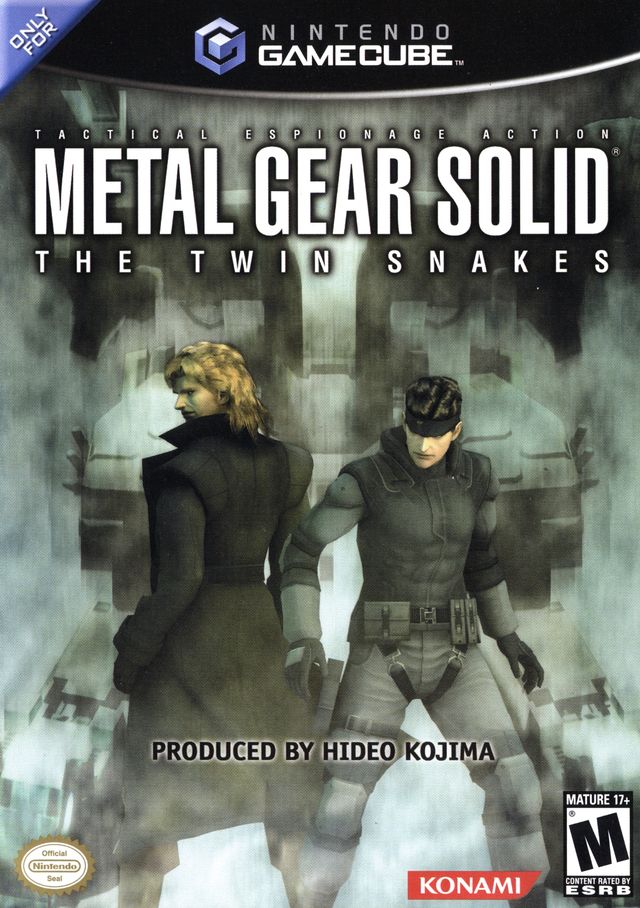
It's not all games for kids, though. Hideo Kojima remade his seminal Metal Gear Solid with The Twin Snakes, exclusively on GameCube. Eternal Darkness: Sanity's Requiem was a milestone in psychological horror, surprisingly published by Nintendo. And outside Nintendo, there's Capcom's beautiful remake of the original Resident Evil, and of course... Resident Evil 4.

Resident Evil 4 is widely considered one of the best games ever made. It eventually landed on other platforms, but it was designed for GameCube. RE4 was part of the "Capcom Five," GameCube-designed games that inevitably ended up on other consoles to make more money. Other members of the Capcom Five? Killer7 and Viewtiful Joe. Ya know.

Speaking of games designed for GameCube then ported elsewhere, there's the home console release of the Greatest Shoot 'Em Up Ever Made, Treasure's Ikaruga. Nintendo is slammed for its lack of third-party support, but in fact, many of the generation's greatest multiplatform releases came to GameCube. Beyond Good & Evil, SoulCalibur II, Prince of Persia...

With the Wii and Wii U, Nintendo has gone in a different direction. The GameCube represents its last attempt at a traditional console. It was misunderstood and glorious. Don't hate on the purple box. It may not have the staggering volume of games that PS2 had, but its games have certainly aged more gracefully than the Xbox's library. One day, GameCube will get the respect it deserves.

Saturday, August 17, 2013

Everyone owns the same ten Nintendo 64 games.

I never owned a Nintendo 64. The only game consoles my parents let me have as a kid were Game Boys. The only time I got to play N64 was when I went to friends' or relatives' houses. It didn't matter where I went: everyone had the same ten games.

People say Sony's first PlayStation "won" the console war against Nintendo, but I definitely saw way more N64s than PS1s. Maybe it's because N64 was aimed at my demographic and PS1 was aimed slightly older. Today, I know a lot of people my age who still have their childhood N64s and play them regularly. Everyone has the same ten games.

Recognize these cartridges?

The launch title

The game people are still playing today

"No screen looking!"

Friday, August 16, 2013

Ranking the Metroid series

Metroid has always been close to my heart. In my "100 greatest games of all time," it was the only series to be represented three times on the list. Choosing between Metroid games is like choosing between my children. So let's do it.

11. Metroid: Other M - Nintendo / Team Ninja / D-Rockets - Wii, 2010

The only Metroid game I actively dislike. It's an admirable risk to try to add dialogue and a wider cast to a series about isolation and solitude. But Nintendo gave the task to Team Ninja, best known for... boob physics. They turned one of gaming's only major strong, independent, non-objectified female protagonists into a woman who longs for nothing more than a man to tell her what to do.

10. Metroid Prime Hunters - Nintendo Software Technology - DS, 2006

Nintendo's attempt to make first-person shooters work on its handheld DS. It's admirable, but it's not the most comfortable control set-up for players. When it comes to gameplay, Hunters has more in common with Halo than with Metroid. None of the series' trademark exploration elements are there, and instead of a lonely, moody atmosphere, Hunters focuses on linear levels and multiplayer deathmatches. Some good remixes of classic Metroid Prime music, though.