Showing posts with label Metroid Prime. Show all posts

Saturday, January 4, 2014

The ten best games of the last console generation, according to Jake

10. Castlevania: Order of Ecclesia - Konami - Nintendo DS - 2008

I've been a sucker for Metroidvania-style gameplay since I was eleven years old. While Metroid has gone on to bigger and better 3D things, Castlevania remained true to its roots and produced a slew of great 2D Metroidvania games in recent years. The series has never quite been able to make the leap to 3D, but that's okay with me.

Order of Ecclesia was the third and final Castlevania game on the DS, the series' swan song on the handheld. It features a refined art style, a more nonlinear gameworld with a brilliant Dracula's castle as well as plenty of non-castle locales, a ramped up difficulty from previous DS entries in the franchise, and *gasp* a female protagonist. What is this, Metroid?! Strangely, there's been no word of a new traditional Metroidvania-style Castlevania game since Order of Ecclesia's release six years ago.

9. NHL 14 - EA Canada - Xbox 360, PlayStation 3 - 2013

This entry counts the 360/PS3 iterations of EA Sports' annual NHL series as a whole, and NHL 14 is the pinnacle. It's not arty or deep. It's just hockey. But it's damn good. The NHL series on the seventh generation of consoles spearheaded the sports game genre's move from arcadey face button-based gameplay to full analog stick control. Instead of pressing A to pass and B to shoot, you actually use the control stick as your hockey stick. Despite my pretentious exterior, NHL is a nuanced, stress-relieving love of mine.

8. Catherine - Atlus - PS3, 360 - 2011

I was skeptical of Catherine at first. I'm generally not a fan of the grind-heavy Japanese role-playing games Atlus is known for. But Catherine is... a puzzle game? About relationships? It's got some lengthy anime cutscenes, which normally I'd be averse to but they're so well-made that I don't mind. Catherine is one of the first major deconstructions of sex and the male mind in the videogame medium, but it's also a complex, difficult puzzle game. It's very Freudian, as you may infer from the screenshot above. One of the most daring games of the last generation, which I've written about before here.

7. Limbo - Playdead - 360, PS3, PC - 2010

Jonathan Blow's Braid gets all the "arty Xbox Live Arcade indie 2D platformer" attention, but Danish studio Playdead's somber black-and-white Limbo is what really got to me. While Braid relies on blocks of text and a heavy-handed message, Limbo simply exists. It's a sort of minimalist Where the Wild Things Are meets Lord of the Flies, but much more bleak. I've written on this blog about how much I love this game before. No dialogue, no HUD, just a boy and a spider.

6. Metroid Prime 3: Corruption - Retro Studios, Nintendo - Wii - 2007

Retro Studios' 2002 opus Metroid Prime on the GameCube is my Favorite Game Ever Made. Metroid Prime 2: Echoes was much darker, tougher, and divisive, and I still loved it. The trilogy comes to an end with Metroid Prime 3: Corruption. It's the Return of the Jedi of Metroid Prime: probably the weakest of the three, but still an epic end to the trilogy. Corruption features multiple planets for Samus to explore, with trippy alien designs abounding. The series' signature atmospheric nonlinear exploration gameplay fine-tuned to perfection. It's a bummer that Retro Studios hasn't returned to the Metroid series since Corruption's release seven years ago.

5. Sid Meier's Civilization V - Firaxis Games, 2K Games - PC - 2010

Together with its expansions Gods & Kings and Brave New World, I've put more hours into Civilization V than anything else on this list. A single game of Civ V could take upwards of five hours to get through. I love this style of "4X" strategy game, since you're not just waging war against other people. You can win through economic victory, diplomatic victory, or any other number of means. Plus you can get nuked by Gandhi. And since it's turn-based instead of real-time, you get to spend forever analyzing each move you make.

4. Deadly Premonition - Access Games - 360, PS3, PC - 2010

Deadly Premonition is not a well-made game. It hardly even qualifies as a seventh-generation console game. It's full of bugs, awkward controls, terrible graphics, and a limited soundtrack. But that's all part of why I love it. Deadly Premonition is a Twin Peaks-inspired comedy horror with tons of personality. The obtuseness of it all is what makes it so appealing. It's a diamond in the rough that's become a cult classic. I've written about it before here.

3. Fallout 3 - Bethesda Game Studios - PC, 360, PS3 - 2008

This entire blog is named after the location of Fallout 3, so I'd hope it would make this list. I've got mixed feelings on open-world games, since they've all got awful pacing and dramatic tension. Bethesda's other open-world RPG series The Elder Scrolls gets much more attention than Fallout, and it's such a self-serious Tolkien ripoff that I never got too into it. But Fallout 3 hits the perfect balance of post-apocalyptic harshness with a sense of gallows humor through it all. Plus I've got the sentimental attachment of it being by far the most detailed depiction of my hometown Washington, D.C. in videogame form.

2. Mirror's Edge - EA Digital Illusions CE - 360, PS3, PC - 2008

Crazy to think after making Mirror's Edge, Swedish studio EA DICE went on to become a generic FPS factory with the Battlefield series. Mirror's Edge is ahead of its time, a first-person parkour game that was a commercial failure but has since gained respect in the gaming community. Its parkour control scheme was a paradigm shift from standard first-person controls, which turned many players off but allowed for a new type of game we haven't really seen before or since. Combine that with a minimalist color palette, airy electronica soundtrack and strong female protagonist, and Mirror's Edge is a classic. 

1. Portal - Valve Corporation - PC, 360, PS3 - 2007

It has to be Portal. It can't be anything else. What else could I choose? Valve's unassuming first-person puzzler Portal is likely the most important game of the last decade. You probably already know about Portal. There are university curriculums based around it. The most fun part of it is the fact that Portal was released with virtually zero fanfare--a short little puzzle game extra thrown in with the already-stellar Orange Box. Valve is undoubtedly the best developer of the last generation of video games, and Portal is perfection in game design.

Monday, August 19, 2013

Nintendo GameCube: the most underrated console ever made

Everyone loves to make fun of Nintendo's purple little box, with its half-size discs and handle on the back. They disparage its fundamental misunderstanding of the gaming market at the time, from lower horsepower than its competitors to lack of online play to a focus on "kiddy" games. It didn't have the huge library that Sony's PlayStation 2 had, and it didn't have the edgy first-person shooters that Microsoft's Xbox had.

But the GameCube is the most underrated system of all time, with some of the most underrated games of all time.


Let's start with the console itself. It's a work of art. While most other consoles look like drab cable boxes, GameCube launched in a pleasant violet color. And everything is exactly where you think it should be. The controller ports are big and right in front, and the discs go right in the top.

The controller is the most ergonomic official first-party controller ever made for a console. It slides into your hands like butter and fits them like a glove. The shoulder triggers are lush and analog, and the satisfyingly large green "A" button is front and center where it should be. The "B" button is smaller and red, as it should be. The Start button is right in the middle, where it should be. None of this superfluous Select button shenanigans. When was the last time you actually needed a Select button? Not to mention the WaveBird, wireless years before Sony or Microsoft produced wireless controllers.

The primary control stick has nice grips on it, and has little guides on the edges to help perfect 8-directional motion. It doesn't have the rubber covering on the control sticks, but that might be a good thing. Compare the control sticks on my first GameCube controller (from 2002) to my first Xbox 360 controller (from 2009):


But a great console is nothing without great games. Games trump all.

What about the launch lineup? When the GameCube came out in 2001, it launched with Star Wars Rogue Squadron II: Rogue Leader, one of the best Star Wars games ever made. And despite being a launch title on an underpowered platform, its cutting-edge graphics still stand out today.

Its other major launch title was Nintendo's own Luigi's Mansion, which I've written about before. It was disparaged at the time because it wasn't a "real" Mario game, and the GameCube was the first Nintendo console not to launch with a Mario title. But Luigi's Mansion flipped convention and used the more interesting Super Mario Bro as its protagonist.

Luigi is shy, unsure of himself, cowardly, which all makes him... human. A much more interesting main character than main man Mario. Luigi's Mansion was able to succeed as a survival-horror game while still being kid-friendly, something rarely seen in gaming.

Perhaps the greatest metaphor for the GameCube in its library is Super Mario Sunshine. It's by far the most widely criticized entry in Nintendo's main Super Mario series. People complained it wasn't a "true" Mario game because of its focus on story and Mario's role as a glorified janitor, cleaning up graffiti around a tropical island.

But isn't Mario's actual profession... plumbing? Not exactly world-saving fare. Super Mario Sunshine took the series in a new direction, providing a unique gameworld for Mario to explore while still giving players a challenge with the platforming segments.

Today, Nintendo is criticized for recycling its Mario formula with predictable entries like New Super Mario Bros. 2 and New Super Mario Bros Wii. I firmly believe Nintendo only started doing this because it got so much crap from everyone for actually trying something new with Sunshine. At the end of the day, Super Mario Sunshine is hands-down the best Mario game.

Nintendo also took its Legend of Zelda series in a new direction on the GameCube. When they announced The Legend of Zelda: The Wind Waker would be cel-shaded and cartoony, Nintendo took a heap of criticism for dumbing down the venerable Zelda name. But when it was released, The Wind Waker was a creative, well-written gem with a unique seafaring setting. Today, Wind Waker is rightly lauded as a bold step in a new direction for the series.

My personal favorite, Metroid Prime is much the same way. Nintendo took a beloved series that had been dormant since 1994 and made it a first-person game. Many fans, myself included, feared this would be a simplified, stupid first-person shooter to appeal to the popularity of Halo. Instead, what we got is perhaps the greatest game ever made. A first-person adventure that stays true to its Metroid roots while courageously taking the series in new directions. I think I like this game. I think I've written about it before.

Nintendo is criticized for all the best-selling games on its consoles being games made by Nintendo themselves. The critics are right, but Nintendo makes some damn fine games.

The definitive versions of perennial multiplayer favorites Mario Kart and Super Smash Bros. are both on GameCube. Mario Kart: Double Dash!! refined the series without dumbing it down for the casual crowd like Mario Kart Wii would. And Super Smash Bros. Melee is still so widely loved that the twelve-year-old game was one of the games played at this year's Evo Championship Series, the most important fighting game competition in the Western world.

Mario Kart isn't the only classic Nintendo racing game on GameCube. F-Zero GX was overlooked by most people, but among hardcore racing fans it's considered one of the toughest, most brutal, greatest racing video games ever made. GX still hasn't seen a sequel.

Speaking of "niche, brutal Nintendo games," Fire Emblem: Path of Radiance was the first 3D entry in the series, and the first home console release of Fire Emblem outside Japan. It's a hardcore tactical role-playing game with permadeath--a game mechanic popularized by DayZ in 2009, but used by Fire Emblem for decades!--that flew under the radar of most gamers.

But GameCube didn't just have great sequels. Animal Crossing and Pikmin are both colorful, genre-bending, kid-friendly-but-deceptively-deep series with devoted fanbases, with their beginnings on GameCube. Today, both series are major players for Nintendo.

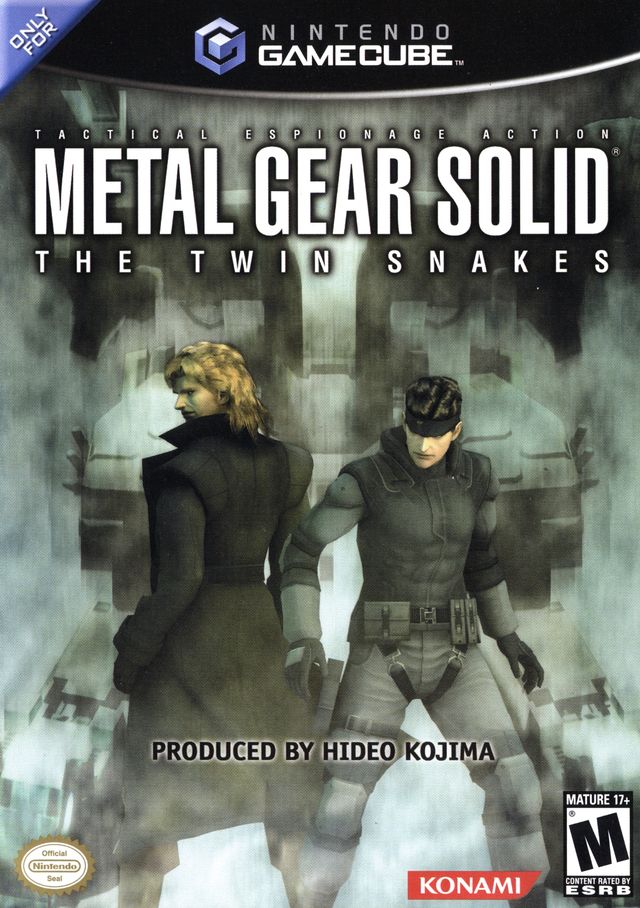
It's not all games for kids, though. Hideo Kojima remade his seminal Metal Gear Solid with The Twin Snakes, exclusively on GameCube. Eternal Darkness: Sanity's Requiem was a milestone in psychological horror, surprisingly published by Nintendo. And outside Nintendo, there's Capcom's beautiful remake of the original Resident Evil, and of course... Resident Evil 4.

Resident Evil 4 is widely considered one of the best games ever made. It eventually landed on other platforms, but it was designed for GameCube. RE4 was part of the "Capcom Five," GameCube-designed games that inevitably ended up on other consoles to make more money. Other members of the Capcom Five? Killer7 and Viewtiful Joe. Ya know.

Speaking of games designed for GameCube then ported elsewhere, there's the home console release of the Greatest Shoot 'Em Up Ever Made, Treasure's Ikaruga. Nintendo is slammed for its lack of third-party support, but in fact, many of the generation's greatest multiplatform releases came to GameCube. Beyond Good & Evil, SoulCalibur II, Prince of Persia...

With the Wii and Wii U, Nintendo has gone in a different direction. The GameCube represents its last attempt at a traditional console. It was misunderstood and glorious. Don't hate on the purple box. It may not have the staggering volume of games that PS2 had, but its games have certainly aged more gracefully than the Xbox's library. One day, GameCube will get the respect it deserves.

Friday, August 16, 2013

Ranking the Metroid series

Metroid has always been close to my heart. In my "100 greatest games of all time," it was the only series to be represented three times on the list. Choosing between Metroid games is like choosing between my children. So let's do it.

11. Metroid: Other M - Nintendo / Team Ninja / D-Rockets - Wii, 2010

The only Metroid game I actively dislike. It's an admirable risk to try to add dialogue and a wider cast to a series about isolation and solitude. But Nintendo gave the task to Team Ninja, best known for... boob physics. They turned one of gaming's only major strong, independent, non-objectified female protagonists into a woman who longs for nothing more than a man to tell her what to do.

10. Metroid Prime Hunters - Nintendo Software Technology - DS, 2006

Nintendo's attempt to make first-person shooters work on its handheld DS. It's admirable, but it's not the most comfortable control set-up for players. When it comes to gameplay, Hunters has more in common with Halo than with Metroid. None of the series' trademark exploration elements are there, and instead of a lonely, moody atmosphere, Hunters focuses on linear levels and multiplayer deathmatches. Some good remixes of classic Metroid Prime music, though.

Monday, December 3, 2012

How a poor camera and awkward controls can be totally RAD


Robot Alchemic Drive (Gigantic Drive in its native Japan), an overlooked Sandlot gem from early in the PlayStation 2’s lifespan, puts players in control of a giant robot controller.  You read that correctly: the player is not given control of a giant robot ,but instead given control of the one who controls a giant robot.  For adequate enough reasons in a videogame, Earth is under attack by giant biomechanical aliens and naturally the only defense against them is a big ol' mecha.  Since this is a Japanese game, the only people with command of a giant robot are three high schoolers.

The melodramatic story is more or less an excuse to justify the gameplay.  Once past the wrapper that is the game's narrative, the player is presented with the inner sweetness that is a gameplay experience unlike anything else (except of course for other Sandlot games involving robots). The crux of this gameplay relies heavily on one of gaming's essential yet oftentimes under-appreciated aspects: controls.  What the game does splendidly is convey that you are in command of a space-age robot with incredible destructive capabilities  This is done by having the Meganite, what the mechs are called, operate via remote control, and wouldn't you know it--that controller is a PS2 DualShock.

QWOP would've been a lot more fun with giant robots

An argument can be made that the best controls are those that do not remain in the consious thoughts of the player and seem to fade away. Yet Robot Alchemic Drive flies in the face of that line of thinking.  At no point did I forget that I was holding a controller. Maybe this can be attributed to its simulator-esque approach. The best way to translate how this control of a controller controls (the Xzibitness of that phrases is not lost on me) a giant robot is that it is a 1:1 scale controller that forgoes the standard macro-like inputs found in most games. Direct control of the limbs are given to the player in a combination of different inputs. The legs are bound to the shoulder buttons with R1/L1 stepping forward and R2/L2 doing the reverse; walking is then an alternating series of R1 and L1 presses which undermines the now common assumption that tilting a stick directs your character in that direction.  The arms are under the dominion of the analog sticks, and different stick motions result in different punches/attacks.  This understandably cumbersome control scheme is partnered with equally lumbering iron giants that, while incredibly responsive to player input, still move without an ounce of grace, making it a game very different from Z.O.E.  This might not be much of an issue in a Final Destination no-items match, but when you are trading blows with a kaiju in the middle of a populated urban center each misstep is another pricey insurance claim and potentially more lives lost. Which makes the player think carefully about each movement as well as plan one step ahead, as the consequences weigh heavily on the conscience of an ally of justice.

Saturday, October 27, 2012

Rebooting Samus: The relationship between East and West in game design, through Metroid Prime


Metroid is Nintendo’s black sheep. While the series has seen just as much critical acclaim as the Japanese gaming giant’s other flagship franchises, Metroid has never been the commercial juggernaut Mario and Zelda are year after year. So when faced with the technological leap from two dimensions to three-dimensional graphics, why did Nintendo for the first time in their history hand over one of its own series to a Western developer? Metroid Prime is the culmination of the company’s marriage of East and West in game design. The unlikely bedfellows of Nintendo and U.S. developer Retro Studios managed to create one of the most successful video games of all time, both critically and commercially.

Gunpei Yokoi with his Game Boy
The series has had Western roots from the beginning. It was conceived by misunderstood designer Gunpei Yokoi—most famous as creator of Game Boy and for ruining his career later with the infamous Virtual Boy. Yokoi took heavy influence from Ridley Scott’s 1979 science-fiction horror opus Alien and the art of Swiss surrealist H.R. Giger. Even before Prime, Metroid was Nintendo’s only franchise directed at an older demographic with a more serious tone, and their only series with better sales numbers in the West than domestically in Japan.

When Metroid was finally handed to a Western developer for the jump to 3D, it wasn’t what you’d call a “smooth transition.” Austin, Texas-based Retro Studios was inexperienced and in shambles with an absent CEO when Nintendo came knocking. And their final product was a first-person game—perhaps the visual perspective most emblematic of Western design. How was this game not a total flop? And how did it consolidate the vast differences between Eastern and Western approaches to video games?

Thursday, February 2, 2012

What Metroid Prime says about Samus, and how it defines East-West relations in game design

Proposal for a 25-page research paper I plan on writing:

Metroid was already Nintendo’s black sheep. While the series has seen just as much critical acclaim as the Japanese gaming giant’s other flagship franchises, Metroid has never been the commercial colossus Mario and Zelda are year after year.

So when faced with the jump from 2D to 3D technology, why did Nintendo for the first time hand over one of its own series to a U.S. developer? 2002’s Metroid Prime is the culmination of Nintendo’s marriage of East and West.

The series was Western from the beginning; its biggest influence was Ridley Scott’s Alien. It’s Nintendo’s only franchise directed at an older demographic with a more serious tone, and their only franchise that sold better in North America than it did in Japan.

And unlike Mario and Zelda, Metroid wasn’t created by Video Game Jesus Shigeru Miyamoto. Samus was conceived by Gunpei Yokoi, most famous for creating the Game Boy and for ruining his career with the infamous Virtual Boy.

It wasn’t just handed over to a Western developer. Metroid was handed to Retro Studios, an inexperienced U.S. developer in shambles with an absent CEO. And they made a first-person game—perhaps the perspective most emblematic of Western design. Through all this, how did they create one of the most critically acclaimed video games of all time?

I’m splitting this paper into three sections: the context of Metroid Prime from Nintendo’s perspective, the development of the game from Retro Studios’ perspective, and an analysis of the game itself, looking at how it represents the marriage of East and West in game design.