Thursday, July 5, 2012

Videogame Storytelling and Plot Twists: Why We Love Plot Twists


German studio Yager Development’s new title Spec Ops: The Line has been making waves throughout the games industry. At first glance, it seems like a generic military shooter… but it gets trippy. It’s loosely based on Joseph Conrad’s Heart of Darkness, and sends players a message different from the standard “shoot things, you’re awesome, bro.” In stark contrast to most military shooters on the market today, Spec Ops actually makes players (gasp!) feel bad about killing hundreds of people.
The Line
Spec Ops: The Line
Why has this change of direction resonated with so many people? In the past decade as videogame storytelling has become slightly more adequate, plot twists have been an important tool for making the player reevaluate their role in the story. Look at any high-profile “arty” success over the past couple years: BioShock, Portal, Braid… they all feature prominent plot twists.
This is because games are still mostly about empowering players. Game mechanics define games, so it’s in developers’ best interest to give the player more abilities and give them more power within the mechanic as the storyline progresses. Most games feature a very linear narrative of “start out weak, get stronger, fight boss, get stronger, fight a stronger boss, repeat.” Sometimes, a game like Metroid will take away all the player’s powers near the beginning of the game, and then the plot revolves entirely around getting powers back.
This comes from the way we as an industry conceive of games. For the most part, the game mechanic is the first idea, and the story evolves around that mechanic. It’s a smart way to create a fitting storyline, but it’s also limiting. Story depends on gameplay, and never vice versa.

Dear Esther
We’re at the unfortunate stage where a “good story with subpar gameplay” is unacceptable, but “great gameplay with mediocre story” is a game we still embrace. Because of this, there’s no motivation for most developers to work on creating better stories–just worry about the gameplay and the story doesn’t matter! Of course, I firmly believe gameplay is integral to our medium, but we’ll never get to “great games with great stories” until we can conquer this fear of deep plotlines.
Because of games’ focus on mechanics and empowering players, games like Portal andBioShock stand out when they throw a wrench in that empowerment. Players want to feel competent and in control, and when we learn otherwise, we’re shocked. Encounters with characters like GLaDOS and Andrew Ryan make us rethink our role in the game world, and that affects us emotionally. Or look at a series like Half-Life; its story draws us in largely because the enigmatic G-Man reveals that even from the beginning of the game, we’re not in control.
But does this mean games HAVE to be this way to make an emotional impact on us? What about a game where the player never gains power in the first place?

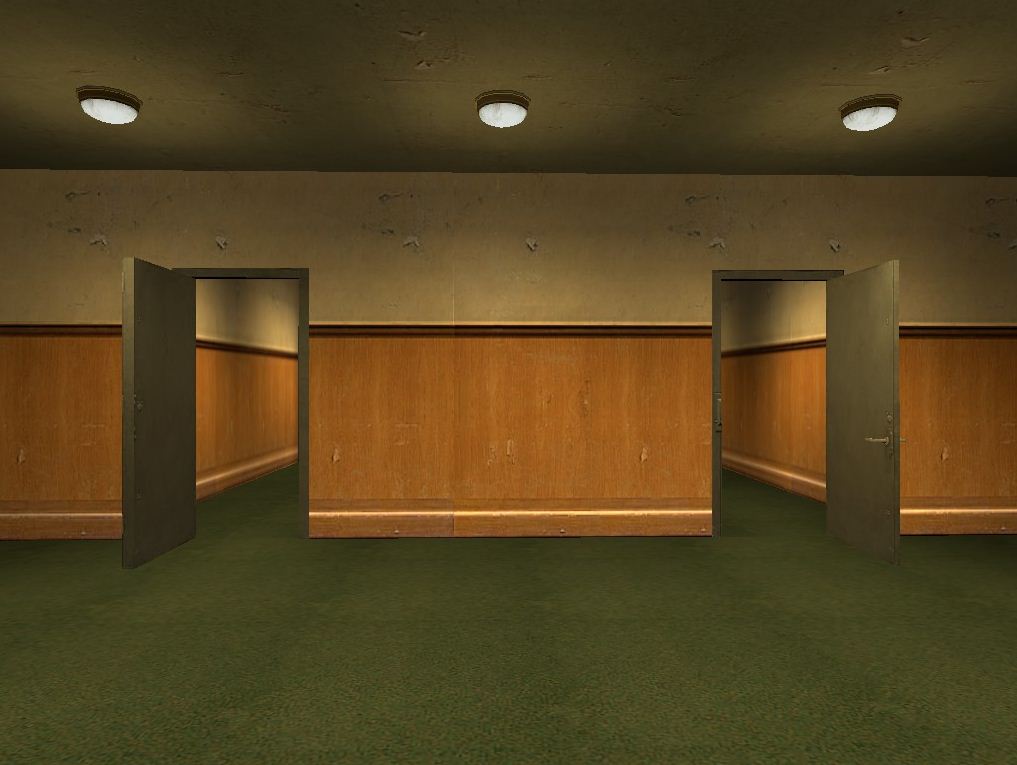
The Stanley Parable
We can look at recent cult hits like The Stanley Parable and Dear Esther as titles where the player never has power, and never has the ability to gain any more. It’s great to see a few titles like this emerge, but of course, they’re still refined to low-budget independent productions. Will we ever see mainstream AAA titles do this?
Going one step further, I’d like to see a game where the player actually ends the game with LESS power than they began with. Perhaps, like Spec Ops, it begins as a cliché military shooter. You have to assassinate some foreign leader in a third-world country. But then some sort of natural disaster derails all your plans. Not an evil genius who the player can then take revenge on. Just a flood or a storm, and the player must simply survive. Without the guns they had before, without the superhuman physical abilities. Going from G.I. Joe to a refugee. When will we see that game?
Would players be unsatisfied to see a game where they end weaker than they began? If anything, this weakening would work to refine the game’s core mechanics, since players couldn’t rely on any superfluous power-ups or add-ons to their abilities.
It’s just a shame that game mechanics force video game storylines into rigidly uniform structures of increasing power. I hope one day we can see it in reverse.

Friday, June 29, 2012

Mixed feelings on Wes Anderson's Moonrise Kingdom

Lars von Trier is a Danish director best known for experimental films like 2009's Antichrist and last year's Melancholia. His next movie is called The Nymphomaniac. It's about a woman's sexual awakening. His explanation for the film's inspiration:
"My director of photography on Melancholia at one point voiced a surprising prejudice. He urged me not to fall into the trap that so many aging directors fall into--that the women get younger and younger and nuder and nuder. That's all I needed to hear. I most definitely intend for the women in my films to get younger and younger and nuder and nuder."
I couldn't keep that quote out of my head when watching a 12-year-old girl wearing heavy make-up and a fetishized schoolgirl outfit undress in Wes Anderson's new film, Moonrise Kingdom. Anderson is only 43; if Lars von Trier's hypothesis is correct, I shudder to think what Wes Anderson will be doing in ten years.

I don't want to come off as sex-negative, though. I consider myself a very liberal person when it comes to what's acceptable in film. But this awkward nudity was representative of Moonrise Kingdom's bigger problem: tonal clash.

Moonrise Kingdom is full of characters with complex, depressing backstories. The main character is a kid who's been orphaned. His love interest is a girl with emotional issues and uncaring parents. Edward Norton plays a scout leader who just wants to lead the troop but can't seem to control his situation at all, and Bruce Willis plays an aging police officer who's afraid of dying alone. Bill Murray is an unhappy husband who is physically abused by his wife.

But it's all got such a happy-go-lucky, "quirky" Wes Anderson attitude! The film sports a colorful 1960s Americana setting, with self-aware, intentionally unrealistic dialogue. This story is one that could be told better in a more un-ironic setting. It's about tortured characters coming to terms with their situations in life, and this doesn't seem to work with Wes Anderson's bright visual aesthetic.

Moonrise Kingdom also seems to be trying to convey a few subtexts. The entire movie is clearly an homage to the "young adult" adventure novels we see the female protagonist reading throughout the story. There also seems to be some sort of Noah's Ark narrative going on, but it's incomplete. There are some nice touches, like kids wearing creepy animal masks (reminiscent of In Bruges and The Wicker Man). But it doesn't seem to add up to anything. Moonrise Kingdom has a satisfyingly happy ending for all its melancholy characters, but I can only imagine the movie would be something more if its director took it more seriously.

I think back to Swedish director Tomas Alfredson's Let the Right One In, a film that conveyed a complex storyline through 12-year-old protagonists in a much more convincing way than Wes Anderson seems capable of. Perhaps the key to unlocking compelling preteen characters is the actors themselves--Alfredson spent almost a year casting the two leads. It shows, as Kåre Hedebrant and Lina Leandersson deliver spectacular performances as protagonists Oskar and Eli. This is something that cannot be understated when child actors are such a hit-or-miss affair.


Wes Anderson's casting, on the other hand, does not fare so well. All the characters in the film are evocative and compelling... except the main character, Sam Shakusky (payed by Jared Gilman). While his love interest Suzy Bishop (Kara Hayward) provides a dark look into child psychology, Sam just falls into the standard "outcast kid" archetype. It's strange, because Wes Anderson has achieved character depth before with movies like The Life Aquatic. Perhaps it's just kids he struggles with--his portrayal of high school in Rushmore was also fairly unconvincing.

Let the Right One In's protagonists, in fact, have many 12-year-old-kid similarities with those of Moonrise Kingdom. Both Oskar and Sam are misunderstood nerdy boys who fall in love with forbidden women. Both Eli and Suzy are more mature than their age indicates; both have mysterious backgrounds and questionable parentage. Both have a pivotal scene in a bathtub.

And while I decried the slightly pedophilic nature of Suzy taking her clothes off, Let the Right One In also features a scene where the female protagonist disrobes and sleeps with the male lead. But with Eli and Oskar, it seems emotional and not out of place at all. After watching Moonrise Kingdom, I can't help but feel Wes Anderson has a lot to learn from Let the Right One In.

Wednesday, June 27, 2012

The most riveting online video game experience of my life

I've become fairly skilled at EA Sports' NHL series as of late. I don't play it for hours at a time, but I play a couple quick games online every day to blow off steam after work.

I'm not a big fan of online multiplayer gaming in general. I even write for a website called Only Single Player. NHL is my exception. I almost don't see it on the same level I see all the "arty" games I play. The other games are there to give me some sort of intellectual fulfillment. NHL is there to fulfill my carnal gaming instincts. I used to play it against the computer, but eventually real human opponents are the only way to truly challenge your skills at a competitive game.


NHL 12 is not a perfect game. Players are assholes online, so they still try to get in fights with you and take shots on goal during every single stoppage in play. And when they get desperate, players online ALWAYS go for the cheap, glitchy wraparound goals. Even after all EA's tweaking, wraparounds are still the best way to take advantage of faults in the goalie's AI.

But on a twitch-impulse gameplay level, NHL 12 is immaculate. The developers have perfected the game's controls--players have total control over every aspect of their virtual pros' skates and sticks.
I've been on a roll lately, winning five games online in a row. They're ranked matches, so if you play well, you get matched up against other players who are of a higher skill level.

Tonight, I played a level 31 match--the highest I've ever played. I was feeling a bit cynical after winning so much, so I decided instead of playing as an NHL club, I'd play as a minor league team. I chose the Hershey Bears, the farm club of my hometown Washington Capitals.

Joel Rechlicz is mediocre at hockey. But in my virtual hockey game, he was vital.

Usually, it's NHL 12 online etiquette that if one player chooses a minor league or European team, the other player does the same so they're on a level playing field. But nope, my opponent tonight stuck with the NHL's St. Louis Blues. "Uh oh," I thought to myself. "This is the highest ranked match I've ever played online, and I'm playing as a minor league club against one of the best teams in the world." And then the game began.

Of course, the Blues scored right away to take an early lead. But amazingly, after endless forechecking and offensive pressure, I got one back! It continued this way through the duration of the game, my opponent and I trading goals--although I never had the lead. It was always St. Louis going ahead, and my team coming back to tie it up.

When my opponent was leading 4-3 in the third period and one of my players took a two-minute penalty, I thought the game was over. But alas, not only did I kill the penalty... I scored a shorthanded goal! Game tied, 4-4!

At this point, my hands were aching. Along with NHL 12's perfect controls come the attrition of constant attention to detail in playing. You can't passively play NHL 12. So not only was I in this heated online matchup, but I was facing the possibility of real-life injury to win the game. NHL features cutscenes during stoppages in play that people normally skip through to get to the real gameplay, but this late in the game I took every breather I could to rest my shaky hands for a few precious seconds.

And with the third period almost over, my star player Joel Rechlicz--perennial minor league enforcer, mediocre goal-scorer--scored his third goal of the night to complete a hat trick and win the game for my Hershey Bears. I nearly cried tears of joy.


This whole experience took about twenty minutes, but it felt like three hours. When the match finally ended and I emerged victorious, I rejoiced like I never have with a video game before.
While many game critics write off sports games as simple diversions, I felt legitimate emotional connection to my experience in NHL 12 tonight.

Sunday, June 3, 2012

Kansas City, I Am Alive, and Lollipop Chainsaw

It's been a while since I've posted. My girlfriend and I have been in the middle of a move to Kansas City, Missouri! Now that we're all set up and I finally got internet in the apartment, I'll get back to my regular writing.

Right before leaving for KC, I finished Ubisoft's I Am Alive. It's received mixed reviews, but I loved it. Although it's obvious the developers wanted to create a more epic game than they were finally allowed, I Am Alive is a fantastic exploration of a nearly dead genre.


Survival-horror, once the bastion of Resident Evil and Silent Hill fame, has devolved into action and explosions. Perhaps this is because higher-fidelity graphics mean modern games don't need to rely on psychological horror to scare players. Perhaps it's because society today is increasingly ADD and doesn't want to spend more than 20 seconds walking through a room without shooting something. Regardless, survival-horror is an increasingly rare genre.

But there is hope! Swedish indie developer Frictional Games has been hard at work carrying the torch (or lantern?) for survival-horror with their Penumbra titles, and most recently, the iconic Amnesia: The Dark Descent. I Am Alive is an Xbox Live Arcade game in that same vein. While not as overtly scary as Amnesia, I Am Alive explores the "survival" part of "survival-horror." Bullets for your pistol are limited. Exposure to the dust around the city causes your stamina to fall. You can't climb forever like Lara Croft without hurting yourself. Most encounters with enemies are an exercise in finding a way to escape without a firefight.

I Am Alive has flaws. It's clear that the game's budget was slashed in the middle of production, with inaccessible areas and an abrupt ending. But the new ideas and unique approach in this title make the download worth it. Its emphasis on the struggle to survive and lack of empowerment of the player is a breath of fresh air in today's industry.

In other news, Suda 51's new effort, Lollipop Chainsaw, comes out on the 12th. And I'm worried. Grasshopper Manufacture's work has been getting increasingly silly and stupid. I know Suda is all about silly, but it seems he's beginning to phone it in. His 2005 opus, Killer7, had plenty of irreverent humor, but it was very dark and creepy at the same time. No More Heroes was less serious and more happy-go-lucky. Then Shadows of the Damned injected even more penis humor. I just hope Lollipop Chainsaw isn't as campy and half-hearted as it sounds like it's going to be.

At least Killer Is Dead has been announced for 2013.

Sunday, February 26, 2012

Cheating in Machinarium

Is a game too hard if the developers have to include an in-depth hint system?

Machinarium, a 2009 point-and-click adventure by Czech company Amanita Design, is beautiful. Its hand-drawn artwork and quirky robot characters are easy to fall in love with. The game has a cohesive style and minimalist storyline delivered without a single word of text. It's the sort of game my non-gaming girlfriend was able to immerse herself in for hours.


But is it too obtuse? As Machinarium revitalizes a genre from a bygone era, it also revives that genre's bygone difficulty. While the characters are expressive and cute, some of the puzzles are devilishly tough to figure out: "move up and down below an electrical wire at a certain spot so the bird sitting on it tries to copy you and falls off, so you can use the puzzle piece in its mouth to complete a jigsaw and use the fallen electrical wire to electrocute a cat, which you then use to scare a rat out of a musician's didgeridoo." And that's only the beginning of the puzzle.

Conveniently, the game features an extensive hint system. For every room, you can either click the hint button to get a slight hint, or play a minigame to acquire an in-depth, play-by-play illustrated walkthrough of that room. The minigame keeps you from overusing the walkthrough, but the fact that it's even there is slightly troubling.

I appreciate tough games, but shouldn't players be able to get through the game without hints? They should have to make the Walk of Shame to GameStop to purchase the Prima strategy guide--it shouldn't be in the game itself, right? If Amanita thought players needed hints to figure the game out, doesn't that mean they recognized the game they were making was too hard for regular people to figure out?

The act of figuring a game out is part of why we play games. It's something only incredibly complex books and movies can accomplish, but something nearly every game requires. This audience involvement makes the medium unique--aren't you taking that away if you use a walkthrough?

Friday, February 10, 2012

Horror and guitars in Metro 2033

I just finished Metro 2033, a 2010 adaptation of the 2005 book by Russian author Dmitry Glukhovsky. Created by Ukrainian developer 4A Games, Metro 2033 is one of the most chilling games I've played in a long time.

The game tells a tale of post-apocalyptic Moscow, where people are forced to live underground in the Metro stations. The structure reminds me of Fallout 3 crossed with Half-Life 2, but with a distinctly Slavic perspective.

It's interesting to play something made in Ukraine. Most video games are either North American or Japanese. Not many are European, and even fewer are Eastern European. The result is a work that could not be replicated in the United States or anywhere else.

Metro 2033 isn't perfect. It's got all the trappings of a survival-horror FPS, and there are some sections that take control away from the player when they should've just let the player experience them on their own, Valve-style. But Metro 2033's atmosphere is melancholy in a way I haven't experienced before. The narrative doesn't spoon-feed you the emotions you're meant to feel as you play through the storyline. Instead, the claustrophobic settlements in the subway stations and the stark icy dystopia of the Muscovite surface seep into the player's psyche. On top of it all, there's a supernatural subtext that's handled beautifully.

The Metro stations are by far my favorite part of the game. Cramped and full of dirty, tattered survivors, these ramshackle subterranean villages provide context for the graveness of Moscow's holocaust. There's no way to "interact" with most of the civilians, per se. Instead, all you can do is walk around and observe these people live their dreary underground lives. The dialogue between all these non-player characters is inconsequential to your story, but they add layers and layers of personality to the world of Metro 2033.

The voice acting here is some of the best I've ever heard in a game (both in English and in Russian--you can play through the game with either audio track), and perhaps because of the work's roots as a novel, the writing is beautiful. Hear two children speculate about what the surface of Moscow (which they've never seen before) is like, or listen to drug addicts argue over their stash. There's nothing tangibly beneficial to you in the game world for listening to these conversations other than to deepen your understanding of the story you're in.


There are a few curious inclusions in these subway towns. First of all, almost every settlement you visit includes someone playing music. There are guitars and other instruments strewn around the game world. And second, there are kids everywhere. Most video games feature few to zero children, but these Metro stations are full of kids. And in a way, it's very unsettling. Will these children ever have a future? Their lives are full of darkness and death.

Which brings me to Metro 2033's understatedly brilliant morality system. Many games have a metered "good or evil" morality bar where doing the right thing or the wrong thing provide clear gameplay advantages and disadvantages. Metro 2033, on the other hand, never tells you it's keeping track of the decisions you make. And instead of obvious "kill this person or spare their life" moral choices, the game judges you on a plethora of tiny decisions. Do you stay and listen to the old lady begging for food? Do you linger in a place and play the piano? These little choices change the trajectory of the story without your knowledge. Really, that's a truer "morality" system than "choose obviously good decision for ___ benefit."

Thursday, February 9, 2012

Why Braid Sucks, Pt. II: The 'A' Button

Building off my rant from yesterday:

One of the single most frustrating parts of Braid's design is in its opening moments: teaching players the game controls. Tutorials are notoriously tough to do well in games, and designer Jonathan Blow had noble intentions of letting the player learn the controls on their own instead of flashing "PRESS 'A' TO JUMP" across the screen. Instead, he did this:


A box near a ledge with a picture of the Xbox 360's 'A' button on it. The player can't jump over this little ledge without pressing 'A', so it forces them to learn that 'A', in fact, makes the character jump.

But this helpful box is unnecessary. It's the 'A' button--the most cardinal of all video game controls. Even the original Nintendo Entertainment System featured the 'A' button to jump in most of its games. Braid itself is a satire of the most iconic "press 'A' to jump" platformer on the NES, Super Mario Bros.

Suffice to say, I doubt anyone savvy enough about video games to purchase Braid would need to be told to press 'A' to jump. This would be like a novel telling the reader "turn the page to read more." I could understand explaining more complex control schemes to players, but 2D platformers like Braid have the most basic and intuitive of all video game control schemes.

Even if someone were playing a platformer for the very first time, when faced with this small ledge to jump over in Braid they'd have no trouble figuring it out. The 'A' button is prominently displayed on the Xbox controller; when one holds the controller, their right thumb naturally rests on 'A'. Not only that, but the button is green--the universal indicator of "press this button."

My second big issue is that the 'A' button onscreen is in a box. In most platformers (including Mario), boxes are something you destroy to reveal a power-up.

When I played Braid for the first time, the first thing I did upon seeing this 'A' box was jump on it and try to open it, to no avail. The three other people I've watched play Braid for the first time have done the exact same.

So not only is Blow's 'A' box redundant as a tutorial mechanism--it's outright unfaithful to the genre whose conventions it's attempting to emulate for dramatic effect.

Wednesday, February 8, 2012

The Great Wall of Text: Why Braid Sucks

Braid is one of the most overrated games of all time. Creator Jonathan Blow is seen as Art Game Jesus, and lives up to that title by traveling the world giving speeches about advancing video games as a medium.

The 2008 game is fantastic. It's got a beautiful visual style, stirring soundtrack, and unique game mechanics that play into the plot. It's a one-of-a-kind satire of Super Mario Bros.

With that said, Braid has no idea how to tell a story. Blow weaves an intricate tale of loss and regret, conveyed mostly through... walls of text.

Jonathan Blow is trying to move games forward as an art form, right? His message comes off as a bit stale when his own magnum opus relies on another medium to tell its story.

I'm not against writing in games. Gaming's history is built on text-based adventures like Colossal Cave Adventure and Zork. Even in modern games, text is often a better choice than the medium's notoriously abysmal voice acting.


But modern games should only rely on walls of text (or cutscenes) when it's absolutely necessary to convey points that couldn't be accomplished within the gameplay itself. As I wrote about yesterday, Valve is great at telling its stories purely within the mechanics of its games. Blow, however, uses copious amounts of text to give Braid meaning. It wouldn't be nearly as bad if his writing wasn't so... mediocre. The story is cliché and the characters bland.

What if he got rid of this? The "loss and regret" themes are still captured in essence through Braid's flowing gameplay. The game would be much more ambiguous, but would perhaps capture Blow's intended emotions in a more pure form if he had avoided the Great Wall of Text.

An example of this in practice is Danish developer Playdead's 2010 avant-garde Limbo. Both Limbo and Braid are indie 2D platformers initially released on Xbox Live Arcade, and both tell the melancholy story of a silent boy searching for a girl.

But perhaps due to their Scandinavian design instincts, Playdead created a much more moving experience with their game. Limbo features absolutely no text, and there's no HUD. None of the characters speak. The minimalist visuals are all in silhouette and even the music is dissonant. Through this, the game conveys pure emotion in a way no other art form can come close to, because the audience is completely involved with it. It's not static... as text is. Jonathan Blow, on the other hand, relegated the majority of his storytelling to text. It's a strange misfire for someone who seeks to be a spokesman for video games as a storytelling medium.

Limbo is the game Braid should have been.

Tuesday, February 7, 2012

The Stanley Parable as a parallel to Portal, and analyzing linear narratives

This past summer, Davey Wreden's Half-Life 2 mod "The Stanley Parable" was released to a wave of critical acclaim. A one-man project that took two years to create, it explores the concepts of player choice and linear narrative in game design. It's mind-boggling.


If you haven't played it, you owe it to yourself to download "The Stanley Parable" right now. It's free, it doesn't even require Half-Life 2 to play (on the PC), and it takes under an hour to do everything there is to do. There's no shooting aliens involved, so even if you don't play many video games, you can appreciate this one.

During my playthrough of "The Stanley Parable," it struck me that many of these themes were similar to another Half-Life 2 spinoff: Valve's own Portal.

Both "The Stanley Parable" and Portal deal with unreliable narrators who may or may not be characters within the game. Both feature silent protagonists who are a tiny part of a giant corporation.

But why? Why does Half-Life inspire such critiques of gamic narrative? The core Half-Life titles themselves involve a silent protagonist and uncertain overlord character. Valve is often put on a pedestal by the gaming community as the pinnacle of Western game design. Story and gameplay interwoven perfectly, with narrative and character development advanced without need for cutscenes.

I'm tempted to be cynical about this canonization of a game developer. But their work really is that good. And if they inspire someone to create something as chillingly beautiful as "The Stanley Parable," I'm okay with that pedestal Valve sits upon.

It was interesting watching my girlfriend (who doesn't play many games) play "The Stanley Parable." Upon learning the plot's twist, she quit the game and shut off the computer. "That's the only way to win the game," she said. And really, I guess she's right.

Thursday, February 2, 2012

What Metroid Prime says about Samus, and how it defines East-West relations in game design

Proposal for a 25-page research paper I plan on writing:

Metroid was already Nintendo’s black sheep. While the series has seen just as much critical acclaim as the Japanese gaming giant’s other flagship franchises, Metroid has never been the commercial colossus Mario and Zelda are year after year.

So when faced with the jump from 2D to 3D technology, why did Nintendo for the first time hand over one of its own series to a U.S. developer? 2002’s Metroid Prime is the culmination of Nintendo’s marriage of East and West.

The series was Western from the beginning; its biggest influence was Ridley Scott’s Alien. It’s Nintendo’s only franchise directed at an older demographic with a more serious tone, and their only franchise that sold better in North America than it did in Japan.

And unlike Mario and Zelda, Metroid wasn’t created by Video Game Jesus Shigeru Miyamoto. Samus was conceived by Gunpei Yokoi, most famous for creating the Game Boy and for ruining his career with the infamous Virtual Boy.

It wasn’t just handed over to a Western developer. Metroid was handed to Retro Studios, an inexperienced U.S. developer in shambles with an absent CEO. And they made a first-person game—perhaps the perspective most emblematic of Western design. Through all this, how did they create one of the most critically acclaimed video games of all time?

I’m splitting this paper into three sections: the context of Metroid Prime from Nintendo’s perspective, the development of the game from Retro Studios’ perspective, and an analysis of the game itself, looking at how it represents the marriage of East and West in game design.

Tuesday, January 31, 2012

Killer7 is why I play video games.

 As I’ve gotten older, I’ve become a pretentious “games as art” person. Nothing sums that up better than Grasshopper Manufacture’s 2005 opus Killer7.

It’s a poorly designed mess. Killer7 is essentially an on-rails shooter with an obtuse storyline and inconsistent difficulty. The controls are awkward and the interface is frustrating to navigate. But perhaps because of all this, Killer7 is beautiful.

This huge barrier to entry and steep learning curve make it all the more satisfying when you can finally comprehend the stylized cel-shaded look and the plot’s dive into Japanese mysticism. The gameplay takes countless twists and turns, and the boss fights are unforgettable.

It’s a game that many people will hate, but if you can get into it, Killer7 pays off in spades. It’s greater than the sum of its parts, and truly a work of art.

What makes this all work is the game’s director, Goichi Suda. He’s something the film industry thrives on, and the video game industry needs more of: Suda is an auteur. He doesn’t use dozens of metrics and playtest a game to death to determine a lowest common denominator of gameplay. He doesn’t care about appealing to the biggest possible audience. Suda makes the games he wants to make.

We need more Suda 51s.

Saturday, January 28, 2012

Rez is just Tetris at a vibrating rave party.

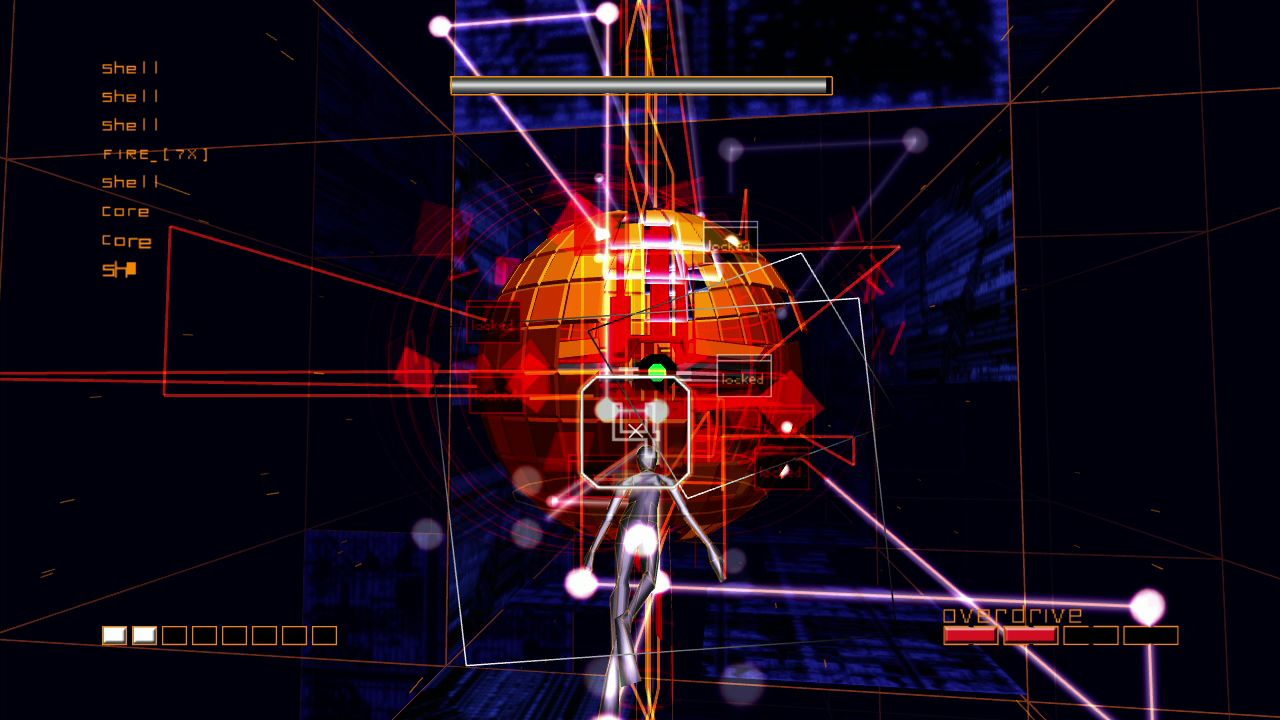
Rez is the point where rail shooters and music games collide. Designed by Tetsuya Mizuguchi of Lumines and Meteos fame, this 1998 Dreamcast/PlayStation 2 game was re-released in HD for Xbox Live Arcade a few years ago. And if you love raves, trance music, and/or do a ton of drugs, Rez is for you. It's a sensory overload.

In a way, Rez is a true successor to Tetris. Like the seminal Soviet puzzler, Rez consists of completely abstract graphics. In Tetris, you control arbitrary colorful blocks falling in an arbitrary pit. In Rez, you control an arbitrary cyber-person shooting arbitrary colorful flying objects. Both games have marginal stories imposed onto them, but plot doesn't matter at all in either game.

And much like Tetris, enjoyment of Rez depends largely on rhythm. Now I know what you're about to say: "But Jake, Tetris isn't a rhythm game!"

Oh, but it is. Tetris is the consummate casual game: you can play it for two minutes, or you can play it for two hours. The reason we're able to fall into a Tetris trance for so long is the rhythm. The Russian soundtrack is classic, but even without the music, players get into a certain groove clearing line after line of blocks.


Rez is the same thing on drugs. The rail shooting isn't an exciting game mechanic, and the enemies are repetitive. But players get into the same groove playing this game that they do playing Tetris.
Mizuguchi takes the rhythmic play to the next level. Rez's levels have psychedelic visuals and a pumping trance music soundtrack. Perhaps the most notable aspect of this rhythm, though, is the vibratin'.


Whether it's the force feedback of shooting a gun in Call of Duty or the pang of hitting the post in FIFA, tactile feedback through the vibration feature of modern game controllers is something players often overlook, but when used correctly, adds to the game experience.
Rez utilizes vibration perhaps more than any game before or since. A subtle buzz accompanies the beat of the game's music, along with the rumble of shots fired. But it doesn't end there. In Rez, players can activate multiple controllers for the sole purpose of "trance vibration"--each controller vibrates for different purposes. It's a genius concept, and more than a little suggestive.

I'd love to see games in the future vibrate the same way Rez does.

Wednesday, November 30, 2011

The House of the Scorpion vs. Blindsight: paratext

Upon starting Nancy Farmer's young adult novel The House of the Scorpion, I was taken aback by the wealth of information. Not at the end of the book, but at the beginning appears a short appendix: a cast of characters and family tree.

This immediately made me think of Peter Watts' Blindsight, another sci-fi book with this sort of paratext, albeit much more in-depth. The House of the Scorpion is intended for "ages 11 and up;" it's preparing middle school kids for books like Blindsight later on in life.

Once I made this connection, more paratext similarities began to appear (by the way, I'm reading the 2004 paperback edition of The House of the Scorpion, and I've got the 2006 paperback edition of Blindsight). Despite having different publishers, both books are nearly the exact same dimensions, and the title pages of both books feature words in black lettering with an accompanying design in gray.

What is the purpose of appendices in books? Why do they appear in science fiction so often, both adult sci-fi and sci-fi for kids? Perhaps it's the very definition of science fiction that we grapple with so often: supernatural worlds justified through specific explanations. Unlike fantasy, science fiction seeks to have rational reasoning for everything going on.

But arguably the most famous appendices for a work of fiction appear at the end of J.R.R. Tolkien's The Lord of the Rings, the quintessential fantasy epic. In fact, Tolkien explains nearly everything in his world; his description of Elvish languages are so detailed that there are people who study it and have learned to speak it in the real world.

Does this make The Lord of the Rings science fiction? Probably not. But it's fun to think about.

Monday, November 21, 2011

Acknowledgements in the Second Person

"Blood makes noise."
-Suzanne Vega

Imagine you are Peter Watts.
     Blindsight is your first novel-length foray into deep space--a domain in which you have, shall we say, limited formal education. In that sense the book isn't far removed from your earlier novels: but whereas you may have not known much about deep-sea ecology either, most of us knew even less, and a doctorate in marine biology at least let you fake it through the rifters trilogy. Blindsight, however, charts its course through a whole different kind of zero g; this made a trustworthy guide that much more important. So first you can thank Prof. Jaymie Matthews of the University of British Columbia: astronomer, partygoer, and vital serial sieve for all the ideas you threw at him. You can also thank Donald Simmons, aerospace engineer and gratifyingly cheap dinner date, who reviewed your specs for Theseus (especially of the drive and the drum), and gave you tips on radiation and the shielding therefrom. Both parties patiently filtered out your more egregious boners. (Which is not to say that none remain in the book, only that those which do result from your negligence, not theirs. Or maybe just because the story called for them.)
     You'd scream if you had the breath.
     David Hartwell, as always, was your editor and main point man at Evil Empire HQ. You suspect Blindsight was a tough haul for both of you: shitloads of essential theory threatened to overwhelm the story, not to mention the problem of generating reader involvement in a cast of characters who were less cuddlesome than usual. You still don't know the extent to which you succeeded or failed, but you've never been more grateful that the man riding shotgun had warmed up on everyone from Heinlein to Herbert.
     Vampires did this all the time, you remember. It was normal for them, it was their own unique take on resource conservation. They could have taught your kind a few things about restraint, if that absurd aversion to right angles hadn't done them in at the dawn of civilization. Maybe they still can.
     The usual gang of fellow writers critiqued the first few chapters of the book and sent you whimpering back to the drawing board: Michael Carr, Laurie Channer, Cory Doctorow, Rebecca Maines, David Nickle, John McDaid, Steve Samenski, Rob Stauffer, and the late Pat York. All offered valuable insights and criticisms at your annual island getaway; Dave Nickle gets singled out for special mention thanks to additional insights offered throughout the year, generally at ungodly hours. By the same token, Dave is exempted from the familiar any-errors-are-entirely-yours schtick that you authors boilerplate onto your acknowledgments. At least some of the mistakes contained therein are probably Dave's fault.
     You think: That can't be right.


Professor Sample told us to re-write an important scene in Peter Watts' Blindsight from a different character's perspective. I suspected most of the class would either do a scene from the very beginning of the novel, or the very end. I spent forever trying to figure out how to do something different.

One of the most notable aspects of Blindsight is the extensive background research Peter Watts did for the book. The novel's notes and references section looks like it came straight out of a science textbook.

It reminds me of the painstakingly detailed appendices at the end of J.R.R. Tolkien's The Lord of the Rings. Tolkien was not only a novelist: he was a philologist at Oxford. Middle-earth is so convincing in his works because it's rooted in Tolkien's deep interest in language and history.

In that same vein, Peter Watts' rich world in Blindsight is rooted in the mountains of scientific research he did beforehand. You don't need to read any of it to enjoy the book--just like you don't need to read the appendices of The Lord of the Rings to appreciate Tolkien. But it adds an element of believability and fullness to the world of the fiction.

So I knew I had to tackle Watts' research for this assignment. But what other perspective could I use?

Another of Blindsight's peculiarities is its strategic use of second-person narrative. Often reserved for Choose Your Own Adventure books, second person aims to immerse the reader more in the story. What better way to approach the research of Blindsight?! I combined the first few paragraphs of the book's acknowledgments section with snippets from the opening second-person narration of Blindsight's actual story.

Despite the commanding "You" article, second person seems more stream-of-consciousness to me than Watts' first-person, even though most of the words are identical. With the perspective flipped, Watts' humble self-effacing comments come off as much more melancholy instead of humorous. The ominous lines from the beginning of the novel add to that.

On a completely unrelated note, this all made me think about second person in video games: is it possible? In a game where you play as not a defined character but a blank slate of a re-nameable, customizable avatar, could you argue it's second-person storytelling? You're not playing as Mario or Master Chief. You're playing as you.

Monday, November 14, 2011

Portal is Metroid

My last posts were about how similar the beginning of Portal is to Lilith's Brood.
As I got to the end of Portal, I realized how similar it is to another important work of sci-fi: Nintendo's 1986 Metroid.

Metroid is notable for being the first major video game with a female protagonist, although this is not a major selling point like it is for a game like Tomb Raider. Main character Samus' gender is not revealed until the very end of the game, when she takes off the helmet of her space suit to reveal that she's a woman.

Samus is a silent protagonist in an orange suit, dropped into an unfamiliar landscape with minimal exposition or context. She treks deeper and deeper into the underground tunnels of the Space Pirate base on planet Zebes. In the final boss battle, she encounters Mother Brain, hooked up to the core of the station and controlling it all. When the antagonist is vanquished, the entire station self-destructs and Samus barely escapes.

When playing Portal with developer commentary, the developers say an original prototype of antagonist GLaDOS was... a floating brain. And then it all clicked.

Chell is a silent protagonist in an orange suit, dropped into an unfamiliar landscape with minimal exposition or context. She treks deeper and deeper into the underground tunnels of the Aperture Science laboratories. In the final boss battle, she encounters GLaDOS, hooked up to the core of the station and controlling it all. When the antagonist is vanquished, the entire station self-destructs and Chell barely escapes.

In class, we talked about how notable it is that Portal is one of the first major games with both a female protagonist and a female antagonist.


Metroid famously has a female protagonist, too, and although brains are fairly genderless, Nintendo felt the need to name the game's antagonist... "Mother" Brain.

Metroid precedes Portal by over two decades.

Tuesday, November 8, 2011

One last note on Portal & Lilith's Brood

After I posted my piece on the incredible similarities between Portal and Lilith's Brood, another thing hit me:

Neither Chell nor Lilith can exit their prison cell. They must wait for their captors to open doors or walls for them. Eventually, their captors give them this ability, but it's still limited compared to what the captors can do. Even with more "freedom," they're still both trapped.

Wednesday, November 2, 2011

Lilith's Brood through the portal of Portal

Alive!
Still alive.
Alive... again.

Are these the opening lines of Lilith's Brood? Or are they lyrics from iconic Portal theme song "Still Alive"? As I opened the book, all I could think about was Valve's sci-fi masterpiece. Little did I know these similarities were more than just skin-deep.


Lilith's Brood is about a strong female character held alone in confinement in a pristine cell by unseen, technologically advanced captors who she initially hears only through some sort of public address system. She begins the story by waking up from slumber--she can't remember how long she slept or how she got to this place. She wears clothing given to her by her captors. As she learns more, she discovers her captors are using her as an experiment, and already surgically "enhanced" her body before her journey even started.

Portal is about a strong female character held alone in confinement in a pristine cell by unseen, technologically advanced captors who she initially hears only through some sort of public address system. She begins the story by waking up from slumber--she can't remember how long she slept or how she got to this place. She wears clothing given to her by her captors. As she learns more, she discovers her captors are using her as an experiment, and already surgically "enhanced" her body before her journey even started.

The stories diverge slightly after the first few chapters, but these similarities are uncanny.

I can't wait to dicuss Portal in class.

Monday, October 24, 2011

Crappy romance novels and Lilith's Brood, or Why Book Covers Matter

The first thing I heard about Lilith's Brood was a disclaimer: don't judge this book by its crappy romance novel cover. A naked woman covering her breasts with her hands, under white sheets.

But this is a classic science-fiction trilogy, I thought to myself. I must perservere!

Despite my most valiant efforts, I can't get past this book cover. Covers make a huge first impression on prospective readers, and I've never understood why they go overlooked so often. Why does the moody painting on The Great Gatsby's cover have to have an unnecessary white box around it? Why can't authors stop their great novels with film adaptations from getting the obligatory movie poster cover?

Imagine if the Beatles hadn't had control over the cover of Sgt. Pepper's Lonely Hearts Club Band or Abbey Road. What about Jimi Hendrix's Axis: Bold as Love or Nirvana's Nevermind or A Tribe Called Quest's Midnight Marauders?

Even in today's music market where album sales are bottoming out and everyone buys 99-cent singles on iTunes, album covers make a difference. When Kanye West released his My Beautiful Dark Twisted Fantasy last year, its cover made perhaps more waves than the music itself. A huge controversy ensued, and regardless of what you think of Kanye's music, it's clear he cares about cover art.

Why can't literature be afforded the same artistic integrity? The most successful novels go through dozens of different book covers, hardly any of them with input from the authors themselves. Sometimes a writer like Shel Silverstein will fight tooth and nail to get exactly the artwork he wants, but then again, Silverstein was also the artist. It's tough for writers who just write.

So what about Lilith's Brood? The woman on the cover barely looks like how protagonist Lilith is described in the novel. The top of the photographed woman's head is blurred out--her only distinguishable traits are her curly hair and that ethnically, she's probably black.

The woman appears to be in a very sensual situation, but this is a disservice to the protagonist--Lilith is an empowered female character. The cover insinuates her sexuality should be front and center in the reader's mind.

Does this matter? Octavia E. Butler, the author, is a bit of an anomaly. In an industry full of nerdy white men, she was one of the only prominent African-American female sci-fi authors. Did Grand Central Publishing give Lilith's Brood a romance novel cover because they think men won't read a book written by a woman? Is the woman on the cover black simply because Butler was black?

At the end of the day, despite whatever cliché your teachers and parents may espouse, book covers matter. They're our portal into the world of the story, and it's a shame the publishing industry wants to make these portals as inconsequential as possible.

Tuesday, October 18, 2011

Violence in We3

I love violence. A list of my all-time favorite movies would undoubtedly include such family-friendly classics as Battle Royale, 28 Days Later, and Kill Bill.

But the violence in Grant Morrison and Frank Quitely's We3 bothers me. It seems unnecessary. Gore has a place in fiction when it serves a purpose, whether that's furthering the storyline or evoking a mood. We3's blood and guts simply evoke the mood of "gross" to me. It doesn't hook me in, it doesn't make me empathize with the characters or despise the characters. It just comes off as frivolous.

Let's take this scene halfway through the comic, for example (I apologize for the low scan quality). Our protagonists are escaping across a bridge when they get ambushed by a horde of cyborg rats. The two-page panel on top is the establishing shot, showing all the action with all the characters on an identifiable background.

Quitely cleverly conveys depth in the image by silhouetting the rats on the bridge supports in the foreground. We see Tinker and Bandit reacting to the attack, snarling with teeth bared. Pirate escapes off to the right. This panel works. It tells the story and illustrates the emotions of the characters. Now let's look closer.

Two triangular panels follow: a close-up of Bandit viciously chomping a rat in two, and the We3 crossing to the other side of the bridge.

What was the point of that chomp?

It illustrates that Bandit is fighting back. But does the scene evolve into a full-on battle between the rats and the We3? Nope. They continue their escape in the next frame. If the chomping frame were taken out completely, the reader would not have lost any information.

"But comic books are more than just the plot line," you may assert. So what deeper feeling does the chomp convey? That Bandit kicks ass? We see plenty of ass kicking through the rest of the comic. That the rats are stupid and expendable? We definitely see that throughout the rest of the story. This particular panel brings absolutely nothing to the table, except for one thing: violence.

This is violence for violence's sake. It's the wrong way to do gore. Yes, the rat's guts are realistic and detailed, but all this does is satisfy readers' bloodlust. It's The Human Centipede of comic book frames.

Don't get me wrong. Gore can be done right. It's even done right in other parts of We3. The early scene where the scientist is demonstrating the drill-rats to government officials comes to mind; this is a scene where the unsettling violence makes us feel a certain way towards the humans involved and helps deepen our attachment to the story. Unfortunately, this is only a small percentage of We3's violence. The rest is like Bandit chomping a rat in half: bloody filler.