Showing posts with label reviews. Show all posts

Saturday, August 10, 2013

Elysium review

I expected the worst when I saw the first trailer for Elysium. South African director Neill Blomkamp's previous movie, District 9, is one of my all-time favorites: a metaphor for apartheid in a grimly beautiful science fiction Johannesburg. It's one of the first things I ever wrote about for this blogElysium just looked like a shallower District 9 with a big Hollywood star, Matt Damon, tacked onto it.

But Elysium delivered. If you couldn't put 2 and 2 together from the trailers, it's a metaphor for class inequality. All the rich people live on the utopian space habitat Elysium. Everyone else is stuck on a polluted, impoverished Earth. It explores the themes of immigration, both by poor Latinos to the United States and by rich white people out to the suburbs.

I didn't realize going into it that Elysium would be so specific and political about America's treatment of undocumented immigrants. Set in a dystopian Los Angeles where the upper class is gone entirely, it's become a predominantly Latino city. The futuristic robot cops patrolling the streets are emblazoned not with "POLICE" but with "POLICÍA". Many of the early expositional scenes are entirely in Spanish, and the de facto language of Los Angeles has become Spanglish.

I loved this. The marketing didn't hint at it at all, but it's a very honest way of dealing with racial inequality in the U.S. But that leads to my #1 problem with the film: Why wasn't Matt Damon's character played by a Latino actor instead?


Damon's acting is great, but the part of protagonist Max Da Costa seems like it was written almost exclusively for a Latino actor. Nearly the entire supporting cast are Latino, and Matt Damon even speaks some Spanish to his friends in the movie. Yes, of course in real life there are Latinos of European descent with white skin and blue eyes like Damon, but Matt Damon isn't hispanic. This would have been the perfect opportunity to advance the career of an up-and-coming Latino actor, but instead we're left with the status quo: White Protagonist Saves the Brown People, an unfortunate trope we see all too often today, one we've even already seen this summer with The Wolverine.

I would say Blomkamp only made the decision for box office sales, but Matt Damon was his third choice for the main character. Blomkamp's first choice was Eminem (hey, he was decent in 8 Mile!), who turned it down because he insisted the film be set in his native Detroit. But Blomkamp's second choice was... Ninja, frontman of the South African rap-rave group Die Antwoord, who turned it down because he didn't want his first film role to be with a fake American accent. I absolutely love Die Antwoord, but I don't think they exactly carry name recognition with most American filmgoers. So obviously Blomkamp was willing to cast a slightly more obscure actor in the main role. It's a bummer he didn't choose a hispanic actor, especially as Latinos become a more widely accepted part of the American cultural patchwork.


You could argue District 9 did the same thing. For a film set in predominantly-black South Africa, the main character was played by white South African Sharlto Copley. But I think it was more justified in District 9, as the racial preconceptions of the white main character are a major part of the storyline.

Monday, July 22, 2013

Reviewing Civilization V: Brave New World

There's not much to say about Brave New World, the second expansion pack for Sid Meier's turn-based strategy goliath Civilization V. If you already play Civ V, you'll love Brave New World. If you don't, it won't make any difference to you. It's roughly the same thing I wrote about the game's first expansion, Gods & Kings.

Managing trade routes

That's not to say Brave New World is unremarkable. If you play Civilization, it's a must-buy. Brave New World adds a ton of depth to an already-deep experience. Developer Firaxis Games has overhauled Civ's culture, diplomacy, and trade mechanics, which is great news for peaceful players like me who want to win matches without resorting to military might.

But the sexiest of the additions, as always, are the new playable civilizations. There are nine: Assyria, Brazil, Indonesia, Morocco, Poland, Portugal, the Shoshone, Venice, and the Zulus. A well-rounded representation of countries from around the world, this brings the total civilization count of Civilization V to an impressive 43.

Archeologists are new units who can excavate "antiquity sites" around the world to add to your culture

The new civs in Brave New World add vastly different play styles to the mix. Venice can't found new cities, and instead relies on buying out friendly city-states. The Shoshone focus on a small number of cities with huge swaths of territory. These civs totally change the dynamic of a match, and are a welcome addition to the tried-and-true Civ gameplay formula.

In a world of downloadable content, the idea of "expansion packs" is becoming outdated. Civilization V itself has had a number of bite-sized DLC packs since its initial release in 2010. In the rare occasion that games today have full-on expansions, it feels like a meaty dinner rather than the slim appetizer of DLC. Brave New World refines Civilization V so much, it's without a doubt the definitive way to play the Civilization series in 2013.

Sunday, July 14, 2013

Dueling review: Pacific Rim

Guillermo del Toro's Pacific Rim came out this week. It's got the giant robots Austin loves and the pretentious arty director I love. Instead of publishing two separate reviews, we've decided to do a DUELING REVIEW. Warning: spoilers aplenty.

AUSTIN: They did it.  It's hard to believe, I know.  Pacific Rim lived up to the hype. The hype bar was set pretty high; I avoided all but the first trailer since they've become "the entire movie in two and a half minutes." Go see Pacific Rim, preferably in IMAX 3D.

JAKE: I thought Pacific Rim was an enjoyable, predictable sci-fi romp with some fantastic mecha art design.


AUSTIN: In case you somehow missed it, I'm pretty into giant robots. I could write a whole blog post dedicated to identifying all the things Pacific Rim reverently drew from. However, Pacific Rim is still its own movie. They're less "hey here's that thing" references and more acknowledgement of the history of giant robot/kaiju media. It's a film that's greater than the sum of its parts.  It's polished and executed superbly. It's not just a movie for people like me, but a movie for everyone.

Tuesday, May 28, 2013

Metro: Last Light review

A while back I reviewed Ukrainian developer 4A Games' cult hit Metro 2033. Based on a series of bestselling Russian novels, Metro was one of my favorite games of 2010. It was flawed, but it was beautiful.

Now the Kiev-based studio is back with a sequel, Metro: Last Light. Despite its publisher THQ giving the studio a tiny budget, imposing terrible working conditions, and folding a few months later, 4A persevered. The game was picked up by German publisher Deep Silver and released earlier this month.

Metro: Last Light serves as a natural progression of Metro 2033. It's set in post-apocalyptic Moscow, where the surface is irradiated and survivors live underground in the tunnels city's Metro system... hence the title. You play as Artyom, a man dealing with the guilt of his murderous past. Guilt is one of the driving themes of the entire story, something carried through until the end credits.

I've had a lifelong love of both post-apocalyptic stories and public transit systems--subways in particular. So Metro is right up my alley; Fallout 3 is perhaps my all-time favorite game largely because of its post-apocalyptic version of my hometown Washington, D.C. Metro system. Last Light's Metro is based on the real-life Moscow Metro with its distinctive circular routes, and it'd be really interesting to take a trip there and see how closely the in-game locations match their real-life counterparts.

If you haven't played the original game, you won't understand much of the plot line, and that's a good thing. Instead of spending the opening hours of the game on exposition introducing you to the characters and setting, Last Light is able to jump right into the meat of the story.

Last Light is also a natural progression from 2033 in terms of gameplay and mechanics. It definitely feels tweaked and upgraded all around, but the core gameplay loop of Metro remains intact.


The game has been described as "Fallout meets Silent Hill." It mixes survival-horror with FPS and stealth mechanics, and the combat is serviceable enough. You've got a wide range of ways to approach obstacles, from ninja-like creeping to Rambo blazin'.

The most interesting gameplay mechanic is the gas mask, carried over from 2033. Anytime you venture to the surface of Moscow, you need to wear a gas mask. You need to make sure you have enough air filters, and you have to manually switch filters when one runs low. Combat has its effects on the mask, cracking the glass and making it harder to see. You can take filters and gas masks from corpses you find around the city if your current one is banged up.

I love to play games slowly and savor the experience, and at first I thought this gas mask stuff would be an unnecessary time-limiting annoyance when I'm trying to survive in an already-hostile world. But in practice, it enriches the experience and made me feel more immersed in the dystopian gameworld. It added the "survival" aspect to "survival-horror." You can survive on the surface for a minute or so without a mask, and some of the most intense experiences I had with Last Light were when I was frantically rushing around the surface sifting through rubble to find a new air filter for my mask.


Luckily, Metro is a series made for slow gamers like me. Where the game truly shines is in the downtime at the various Metro stations around Moscow. It's not an RPG, but you're free to explore the heavily-populated stations at your leisure. Unlike many games in which NPCs have fake conversations for a few seconds, in Metro, you can sit and listen to random underground citizens talk to each other for minutes on end. You don't need to listen to any of them, but if you do, it enriches the game's fiction and makes you feel like part of a larger world.

Wednesday, October 3, 2012

Looking back at Dear Esther


After emerging as a Source engine mod in 2008 and a full-blown title of its own on PC this past Valentine’s Day, British indie developer thechineseroom’s cult classic Dear Esther finally released on Mac in June. Being the arty-farty gamer I am, I was curious to see if it lived up to the hype.
The debate surrounding Dear Esther centers around the question of “Is this a game?” It’s a first-person adventure title where the player simply wanders around a mysterious Scottish island, listening to a narrator speak about a woman named Esther. Players don’t solve puzzles or fight enemies. They simply walk around and listen. Is this even a game?
To me, it is. No question about it. It involves player input. We as an industry are so hung up on scores and rules and action. To me, Dear Esther is the gaming equivalent of a Gus van Sant film. You simply take in your surroundings, think about the meaning of it all, and get what you want out of it. There’s no real payoff at the end or decisive goal to be achieved. And that’s the beauty of it. As the games industry grows more mature in the coming decades, I look forward to seeing more games that occupy these shades of gray in defining what “gameplay” means.
While video games are great at appealing to our carnal instincts and guttural emotions, we’re starting to see a few like Dear Esther that require a bit more thought to appreciate. It’s a solemn, lonely game. I’m torn on the narration–sometimes it comes off as corny and melodramatic, but sometimes the writing is brilliant. What sets Dear Esther apart from other recent art-game hits like Limbo and Journey is that Dear Esther isn’t stylized at all. Many of these cult hits forgo graphic realism for exaggerated looks that make it easy to create evocative art. Dear Esther, on the other hand, aims for complete realism in its visual design. That’s what makes the work so moving, and what makes it even more surreal in the game’s stranger segments.
Dear Esther has a very strong sense of place. It’s a British video game taking place in Britain, and it couldn’t have been made anywhere else. The location and mood are so unique to that part of the world, and it’s something I’d like to see more often as the games industry diversifies from American/Japanese dominance to a global art form with developers all around the globe.
The game’s developer, thechineseroom, is currently working in collaboration with Swedish indie studio Frictional Games on a sequel to their own atmospheric first-person cult classic, Amnesia. It looks gorgeous.
Dear Esther is $10 on Steam, and is available both on PC and Mac. It takes an hour or two to finish, but if you like it you’ll want to play it over again. If you love Call of Duty, you’ll hate Dear Esther.

Tuesday, October 2, 2012

Looking back at Civilization V: Gods & Kings

When Civilization V was released back in 2010, there were grumbles from the fanbase. While it was critically acclaimed and sold fairly well, hardcore Civ players complained that in terms of depth, it was a step down from its predecessor Civilization IV. Not only was religion removed from the game, but Civ V seemed to have an increased focus on combat. This clashes with the series’ selling point, that you can conquer the world however you want–through military power, scientific discovery, or diplomatic prowess.

The game’s first expansion, Gods & Kings, seeks to remedy that. It adds espionage and religion back into the mix as game mechanics, and further refines Civ V‘s existing ones. In addition, we get nine new civilizations to play as, and three new scenarios. It’s everything a Civilization addict could ask for!

In the age of downloadable content, modern expansion packs for computer games sit in an awkward position. Ten years ago, expansions were the only way to add more to a game. Today with digital distribution, microtransactions and lots of little downloadable content is the way to go. So it’s not often that we see a big, fully-priced $30 expansion pack anymore. Even Civ V itself has had its fair share of map packs released. Thirty bucks is a bit steep, but if you’re a fan of Sid Meier’s work, Gods & Kings is completely worth it.
On the surface, the three new scenarios to play are the most exciting addition. There’s “Into the Renaissance,” which emphasizes the game’s new religion mechanic. There’s “Fall of Rome,” which focuses on… the fall of Rome. And the most high-profile is “Into the Smoky Skies,” which re-imagines the game’s technology tree in a steampunk direction. These are all fun distractions, but long-term Civ players know this isn’t where the bulk of the gameplay is. They all warrant a couple play-throughs, but where Civilization thrives is its standard customizable matches.
Really, where Gods & Kings shines is the nuts and bolts. Religion and espionage are great additions to deepen the gameplay–religion can affect your influence on other civilizations, and espionage lets you gather intelligence on enemies (or friends). But to me, the greatest change is in the player’s relationship with city-states.
This isn’t going to make much sense to non-Civ players, which is very telling. If you’re not already a fan of CivilizationGods & Kings is definitely not going to win you over. The expansion is aimed squarely at people who are already fans of the franchise, both current Civ V players and fans of Civ IV who were turned off by the relative simplicity of the new iteration.
Previously in Civilization V, your interactions with city-states (small NPC-controlled civilizations that never expand past one city) were limited. You could give them gifts, or they could give you a simple task to complete such as “discover a natural wonder” or “destroy a nearby barbarian encampment.” This would affect your influence on the city-state, which would determine who they would side with in your interactions with the bigger civilizations.
Gods & Kings totally overhauls the city-state system. Religion and espionage both impact your influence on a city-state, and their requests from you are now much more diverse and change more often. Now, they’ll seek investors for 30 turns, or they’ll ask you to bully another city-state. It keeps the city-state interactions fresh, and ensures you can pour another 200 hours into this game without getting bored.
When it comes to the game’s meat and potatoes, there’s a lot of new material to explore. In addition to all the existing civilizations, Gods & Kings introduces nine new playable civs: Austria, the Byzantine Empire, ancient Carthage, the Celts, Ethiopia, the Huns, the Mayans, the Netherlands, and Sweden, as well as Mongolia and Spain (which were included in previous Civ V DLC). I only wish the developers would’ve completed the job and included all the other civilizations from previous DLC: Babylon, Denmark, the Incas, Korea, and Polynesia are all absent from Gods & Kings. Fear not, though; if you’ve already purchased these other civs, they’ll integrate into Gods & Kings, too.
The expansion also a bunch of new units, buildings, and wonders for your cities to produce. This is in the interest of further balancing the game, as well as creating a more fleshed-out “modern” era; previously, players jumped from the industrial era to the modern era to the future era, and that was that. Now, there’s an atomic era and an information era, with units and buildings to reflect them such as bomb shelters and internet firewalls.
Overall, if you’re not already into Civilization, you won’t be converted by Gods & Kings. But if you like Sid Meier’s franchise at all–whether you’re already a Civ V player or your last outing was IV–it’s well worth $30 of content.

Monday, October 1, 2012

Looking back at Lollipop Chainsaw

I was skeptical about Lollipop Chainsaw. Suda 51 is one of my all-time favorite game designers; his avant-garde 2005 opus Killer7 is what made me realize video games could be art. But his past few games have been progressively more disappointing, perhaps as his studio Grasshopper Manufacture has become more successful. FromNo More Heroes to its sequel to last year’s Shadows of the Damned, Suda has become slightly more… mainstream.

While Grasshopper’s schtick has always been irreverent silliness, a punk-rock attitude, and over-the-top action, the gameplay has become more generic. Killer7 was silly, but it also had a very dark tone. Its “kinda-sorta on-rails shooter but not really” gameplay was hard to grasp, but once you got the hang of it, the strange controls only added to the experimental experience. He hasn’t quite recaptured that essence since.


When I saw the first trailer for Lollipop Chainsaw mere months after Shadows of the Damned was released, my eyes rolled. Zombies? Really? I’ve had enough of zombies. I once called myself a zombie enthusiast, even attending my local Washington, D.C. zombie lurch. But the last five years or so, we’ve seen more zombie movies, video games, and books to last me a lifetime. The undead are played out at this point. Let’s move on to something else!
So I was not excited for what looked like Suda 51 playing it safe–a hack-and-slash game featuring a high-school cheerleader hunting zombies with a chainsaw while wearing the dismembered still-alive head of her boyfriend as a keychain. It looked like the goofiness of No More Heroes and Shadows of the Damned without the mature undertones of Killer7. Much like its eponymous sugary treat, Lollipop Chainsaw looked like empty calories. Was my prediction correct?
Mostly. The game’s plotline is just as zany as one would expect from Grasshopper Manufacture. The gameplay consists of six linear levels (plus a prologue level) where protagonist Juliet Starling must essentially “kill all the zombies and get to the next stage.” It’s a short game, but I’ve always been an advocate for short games–I’d rather play seven hours of great gameplay than twenty hours of just-okay gameplay, and sometimes a concept only lends itself to short-form game design. Lollipop Chainsaw is one of those concepts, and that’s fine with me.
While the combat at first seems like shallow button-mashing, learning combos makes for a fairly deep game mechanic. Players earn coins by defeating enemies, and can use them to upgrade Juliet’s abilities as well as unlock goodies like alternate costumes and concept art. The game does fall victim to the Quick Time Event Craze, but in the context of this hack-and-slash game, it’s excusable. Each level ends in a boss fight, and anyone who’s played a Grasshopper game before knows this is one of their strengths–crazy, inventive boss battle design. Without committing the mortal sin of spoilers, I can say each boss in Lollipop Chainsaw is inspired by a genre of music. And they all live up to Suda 51′s standard–it’s definitely worth getting through even the most tedious level to see the ingenious boss at the end.
Where Lollipop Chainsaw shines is the presentation. It’s utterly fantastic. Cutscenes are beautiful, and the comic book-inspired interface makes navigating menus a joy. The dialogue was written by Hollywood director James Gunn, and it shows through constantly stupid-but-well-written quips, especially from Juliet’s beheaded boyfriend Nick.
The standout, though, is the jaw-droppingly epic soundtrack. Grasshopper’s games always have great music, and composer Akira Yamaoka (of Silent Hill fame) returns after penning the music for Shadows of the Damned. Collaborating with Mindless Self Indulgence singer Jimmy Urine, the game’s soundtrack spans everything from death metal to ’80s teen pop to… dubstep (ugh). And for the first time in a Grasshopper game there’s an extensive list of brilliant licensed music, as well. Never before did I think I’d play a video game featuring both the stupid early ’80s hit song Pac-Man Fever” AND Finnish power metal band Children of Bodom. The most iconic song for Lollipop Chainsaw, of course, is the classic “Lollipop” by ’50s a cappella group the Chordettes.
Which brings me to the game’s level design. Huh? From the soundtrack to level design? See, Suda 51 always manages to fit one super drug-induced level into each game he makes. In Lollipop Chainsaw, Juliet is casually perusing a farm in one level when she accidentally does ‘shrooms… which leads to a trip-fueled level of killing giant chickens and running over zombies with a tractor while listening to “You Spin Me Round (Like a Record)”by ’80s new wave group Dead or Alive (you know, the song from that website… cough cough). This pairing of gameplay and music may be the greatest in the history of this video games.
Like many Japanese games, though, there are a few cultural issues. First and foremost, Juliet herself. As an adult with dignity and a significant other, I couldn’t help but feel a little awkward with the fetishized “sexy schoolgirl” look of the game’s protagonist. Juliet brings up the same dichotomy first seen in Tomb Raider‘s Lara Croft: on one hand, it’s this very objectified vision of what a woman looks like, but on the other hand, it’s an empowered female character kicking ass. The importance of this can’t be understated in a gaming industry where male protagonists are still the norm.
But still, it’s a bit creepy when one realizes most of these beautiful virtual women in games are likely created by male programmers. Lollipop Chainsaw makes a point of letting us know that the game’s story all takes place on Juliet’s 18th birthday–as if to tell us “she’s a sexy high school cheerleader, but she just turned 18 so you don’t have to feel like a pedophile!”
Then there’s one of the game’s bosses, Josey. Video games have traditionally been created by white and Asian development teams, and as a result, our industry has an embarrassing track record with black characters. Japanese developers in particular seem to be a bit more out of touch than Western studios. Lollipop Chainsaw features Josey, a boss meant to be some sort of auto-tuned funk mash-up of George Clinton, Rick James, and T-Pain.
Of course he plays ambiguous funk/hip-hop music, and rides around on a UFO with two white women in bikinis. But it doesn’t end there. On top of the flamboyant gear you’d expect from this type of character, he wears voodoo skull make-up and a necklace of shrunken heads. This is a special sort of cultural ignorance all too common in Japanese video games.
But I digress. Lollipop Chainsaw is a fairly standard hack-and-slash action game with fantastic presentation. It’s another step down for Suda 51 and Grasshopper Manufacture, but the mushroom trip level keeps my hope alive that they still have the spark to create truly experimental games in the future. I recommend Lollipop Chainsaw to fans of Grasshopper, zombie aficionados, and anyone who loves heavy metal and/or punk rock. The soundtrack alone is worth buying the game for.


Friday, June 29, 2012

Mixed feelings on Wes Anderson's Moonrise Kingdom

Lars von Trier is a Danish director best known for experimental films like 2009's Antichrist and last year's Melancholia. His next movie is called The Nymphomaniac. It's about a woman's sexual awakening. His explanation for the film's inspiration:
"My director of photography on Melancholia at one point voiced a surprising prejudice. He urged me not to fall into the trap that so many aging directors fall into--that the women get younger and younger and nuder and nuder. That's all I needed to hear. I most definitely intend for the women in my films to get younger and younger and nuder and nuder."
I couldn't keep that quote out of my head when watching a 12-year-old girl wearing heavy make-up and a fetishized schoolgirl outfit undress in Wes Anderson's new film, Moonrise Kingdom. Anderson is only 43; if Lars von Trier's hypothesis is correct, I shudder to think what Wes Anderson will be doing in ten years.

I don't want to come off as sex-negative, though. I consider myself a very liberal person when it comes to what's acceptable in film. But this awkward nudity was representative of Moonrise Kingdom's bigger problem: tonal clash.

Moonrise Kingdom is full of characters with complex, depressing backstories. The main character is a kid who's been orphaned. His love interest is a girl with emotional issues and uncaring parents. Edward Norton plays a scout leader who just wants to lead the troop but can't seem to control his situation at all, and Bruce Willis plays an aging police officer who's afraid of dying alone. Bill Murray is an unhappy husband who is physically abused by his wife.

But it's all got such a happy-go-lucky, "quirky" Wes Anderson attitude! The film sports a colorful 1960s Americana setting, with self-aware, intentionally unrealistic dialogue. This story is one that could be told better in a more un-ironic setting. It's about tortured characters coming to terms with their situations in life, and this doesn't seem to work with Wes Anderson's bright visual aesthetic.

Moonrise Kingdom also seems to be trying to convey a few subtexts. The entire movie is clearly an homage to the "young adult" adventure novels we see the female protagonist reading throughout the story. There also seems to be some sort of Noah's Ark narrative going on, but it's incomplete. There are some nice touches, like kids wearing creepy animal masks (reminiscent of In Bruges and The Wicker Man). But it doesn't seem to add up to anything. Moonrise Kingdom has a satisfyingly happy ending for all its melancholy characters, but I can only imagine the movie would be something more if its director took it more seriously.

I think back to Swedish director Tomas Alfredson's Let the Right One In, a film that conveyed a complex storyline through 12-year-old protagonists in a much more convincing way than Wes Anderson seems capable of. Perhaps the key to unlocking compelling preteen characters is the actors themselves--Alfredson spent almost a year casting the two leads. It shows, as Kåre Hedebrant and Lina Leandersson deliver spectacular performances as protagonists Oskar and Eli. This is something that cannot be understated when child actors are such a hit-or-miss affair.


Wes Anderson's casting, on the other hand, does not fare so well. All the characters in the film are evocative and compelling... except the main character, Sam Shakusky (payed by Jared Gilman). While his love interest Suzy Bishop (Kara Hayward) provides a dark look into child psychology, Sam just falls into the standard "outcast kid" archetype. It's strange, because Wes Anderson has achieved character depth before with movies like The Life Aquatic. Perhaps it's just kids he struggles with--his portrayal of high school in Rushmore was also fairly unconvincing.

Let the Right One In's protagonists, in fact, have many 12-year-old-kid similarities with those of Moonrise Kingdom. Both Oskar and Sam are misunderstood nerdy boys who fall in love with forbidden women. Both Eli and Suzy are more mature than their age indicates; both have mysterious backgrounds and questionable parentage. Both have a pivotal scene in a bathtub.

And while I decried the slightly pedophilic nature of Suzy taking her clothes off, Let the Right One In also features a scene where the female protagonist disrobes and sleeps with the male lead. But with Eli and Oskar, it seems emotional and not out of place at all. After watching Moonrise Kingdom, I can't help but feel Wes Anderson has a lot to learn from Let the Right One In.

Sunday, February 26, 2012

Cheating in Machinarium

Is a game too hard if the developers have to include an in-depth hint system?

Machinarium, a 2009 point-and-click adventure by Czech company Amanita Design, is beautiful. Its hand-drawn artwork and quirky robot characters are easy to fall in love with. The game has a cohesive style and minimalist storyline delivered without a single word of text. It's the sort of game my non-gaming girlfriend was able to immerse herself in for hours.


But is it too obtuse? As Machinarium revitalizes a genre from a bygone era, it also revives that genre's bygone difficulty. While the characters are expressive and cute, some of the puzzles are devilishly tough to figure out: "move up and down below an electrical wire at a certain spot so the bird sitting on it tries to copy you and falls off, so you can use the puzzle piece in its mouth to complete a jigsaw and use the fallen electrical wire to electrocute a cat, which you then use to scare a rat out of a musician's didgeridoo." And that's only the beginning of the puzzle.

Conveniently, the game features an extensive hint system. For every room, you can either click the hint button to get a slight hint, or play a minigame to acquire an in-depth, play-by-play illustrated walkthrough of that room. The minigame keeps you from overusing the walkthrough, but the fact that it's even there is slightly troubling.

I appreciate tough games, but shouldn't players be able to get through the game without hints? They should have to make the Walk of Shame to GameStop to purchase the Prima strategy guide--it shouldn't be in the game itself, right? If Amanita thought players needed hints to figure the game out, doesn't that mean they recognized the game they were making was too hard for regular people to figure out?

The act of figuring a game out is part of why we play games. It's something only incredibly complex books and movies can accomplish, but something nearly every game requires. This audience involvement makes the medium unique--aren't you taking that away if you use a walkthrough?

Friday, February 10, 2012

Horror and guitars in Metro 2033

I just finished Metro 2033, a 2010 adaptation of the 2005 book by Russian author Dmitry Glukhovsky. Created by Ukrainian developer 4A Games, Metro 2033 is one of the most chilling games I've played in a long time.

The game tells a tale of post-apocalyptic Moscow, where people are forced to live underground in the Metro stations. The structure reminds me of Fallout 3 crossed with Half-Life 2, but with a distinctly Slavic perspective.

It's interesting to play something made in Ukraine. Most video games are either North American or Japanese. Not many are European, and even fewer are Eastern European. The result is a work that could not be replicated in the United States or anywhere else.

Metro 2033 isn't perfect. It's got all the trappings of a survival-horror FPS, and there are some sections that take control away from the player when they should've just let the player experience them on their own, Valve-style. But Metro 2033's atmosphere is melancholy in a way I haven't experienced before. The narrative doesn't spoon-feed you the emotions you're meant to feel as you play through the storyline. Instead, the claustrophobic settlements in the subway stations and the stark icy dystopia of the Muscovite surface seep into the player's psyche. On top of it all, there's a supernatural subtext that's handled beautifully.

The Metro stations are by far my favorite part of the game. Cramped and full of dirty, tattered survivors, these ramshackle subterranean villages provide context for the graveness of Moscow's holocaust. There's no way to "interact" with most of the civilians, per se. Instead, all you can do is walk around and observe these people live their dreary underground lives. The dialogue between all these non-player characters is inconsequential to your story, but they add layers and layers of personality to the world of Metro 2033.

The voice acting here is some of the best I've ever heard in a game (both in English and in Russian--you can play through the game with either audio track), and perhaps because of the work's roots as a novel, the writing is beautiful. Hear two children speculate about what the surface of Moscow (which they've never seen before) is like, or listen to drug addicts argue over their stash. There's nothing tangibly beneficial to you in the game world for listening to these conversations other than to deepen your understanding of the story you're in.


There are a few curious inclusions in these subway towns. First of all, almost every settlement you visit includes someone playing music. There are guitars and other instruments strewn around the game world. And second, there are kids everywhere. Most video games feature few to zero children, but these Metro stations are full of kids. And in a way, it's very unsettling. Will these children ever have a future? Their lives are full of darkness and death.

Which brings me to Metro 2033's understatedly brilliant morality system. Many games have a metered "good or evil" morality bar where doing the right thing or the wrong thing provide clear gameplay advantages and disadvantages. Metro 2033, on the other hand, never tells you it's keeping track of the decisions you make. And instead of obvious "kill this person or spare their life" moral choices, the game judges you on a plethora of tiny decisions. Do you stay and listen to the old lady begging for food? Do you linger in a place and play the piano? These little choices change the trajectory of the story without your knowledge. Really, that's a truer "morality" system than "choose obviously good decision for ___ benefit."

Wednesday, February 8, 2012

The Great Wall of Text: Why Braid Sucks

Braid is one of the most overrated games of all time. Creator Jonathan Blow is seen as Art Game Jesus, and lives up to that title by traveling the world giving speeches about advancing video games as a medium.

The 2008 game is fantastic. It's got a beautiful visual style, stirring soundtrack, and unique game mechanics that play into the plot. It's a one-of-a-kind satire of Super Mario Bros.

With that said, Braid has no idea how to tell a story. Blow weaves an intricate tale of loss and regret, conveyed mostly through... walls of text.

Jonathan Blow is trying to move games forward as an art form, right? His message comes off as a bit stale when his own magnum opus relies on another medium to tell its story.

I'm not against writing in games. Gaming's history is built on text-based adventures like Colossal Cave Adventure and Zork. Even in modern games, text is often a better choice than the medium's notoriously abysmal voice acting.


But modern games should only rely on walls of text (or cutscenes) when it's absolutely necessary to convey points that couldn't be accomplished within the gameplay itself. As I wrote about yesterday, Valve is great at telling its stories purely within the mechanics of its games. Blow, however, uses copious amounts of text to give Braid meaning. It wouldn't be nearly as bad if his writing wasn't so... mediocre. The story is cliché and the characters bland.

What if he got rid of this? The "loss and regret" themes are still captured in essence through Braid's flowing gameplay. The game would be much more ambiguous, but would perhaps capture Blow's intended emotions in a more pure form if he had avoided the Great Wall of Text.

An example of this in practice is Danish developer Playdead's 2010 avant-garde Limbo. Both Limbo and Braid are indie 2D platformers initially released on Xbox Live Arcade, and both tell the melancholy story of a silent boy searching for a girl.

But perhaps due to their Scandinavian design instincts, Playdead created a much more moving experience with their game. Limbo features absolutely no text, and there's no HUD. None of the characters speak. The minimalist visuals are all in silhouette and even the music is dissonant. Through this, the game conveys pure emotion in a way no other art form can come close to, because the audience is completely involved with it. It's not static... as text is. Jonathan Blow, on the other hand, relegated the majority of his storytelling to text. It's a strange misfire for someone who seeks to be a spokesman for video games as a storytelling medium.

Limbo is the game Braid should have been.

Tuesday, February 7, 2012

The Stanley Parable as a parallel to Portal, and analyzing linear narratives

This past summer, Davey Wreden's Half-Life 2 mod "The Stanley Parable" was released to a wave of critical acclaim. A one-man project that took two years to create, it explores the concepts of player choice and linear narrative in game design. It's mind-boggling.


If you haven't played it, you owe it to yourself to download "The Stanley Parable" right now. It's free, it doesn't even require Half-Life 2 to play (on the PC), and it takes under an hour to do everything there is to do. There's no shooting aliens involved, so even if you don't play many video games, you can appreciate this one.

During my playthrough of "The Stanley Parable," it struck me that many of these themes were similar to another Half-Life 2 spinoff: Valve's own Portal.

Both "The Stanley Parable" and Portal deal with unreliable narrators who may or may not be characters within the game. Both feature silent protagonists who are a tiny part of a giant corporation.

But why? Why does Half-Life inspire such critiques of gamic narrative? The core Half-Life titles themselves involve a silent protagonist and uncertain overlord character. Valve is often put on a pedestal by the gaming community as the pinnacle of Western game design. Story and gameplay interwoven perfectly, with narrative and character development advanced without need for cutscenes.

I'm tempted to be cynical about this canonization of a game developer. But their work really is that good. And if they inspire someone to create something as chillingly beautiful as "The Stanley Parable," I'm okay with that pedestal Valve sits upon.

It was interesting watching my girlfriend (who doesn't play many games) play "The Stanley Parable." Upon learning the plot's twist, she quit the game and shut off the computer. "That's the only way to win the game," she said. And really, I guess she's right.

Saturday, January 28, 2012

Rez is just Tetris at a vibrating rave party.

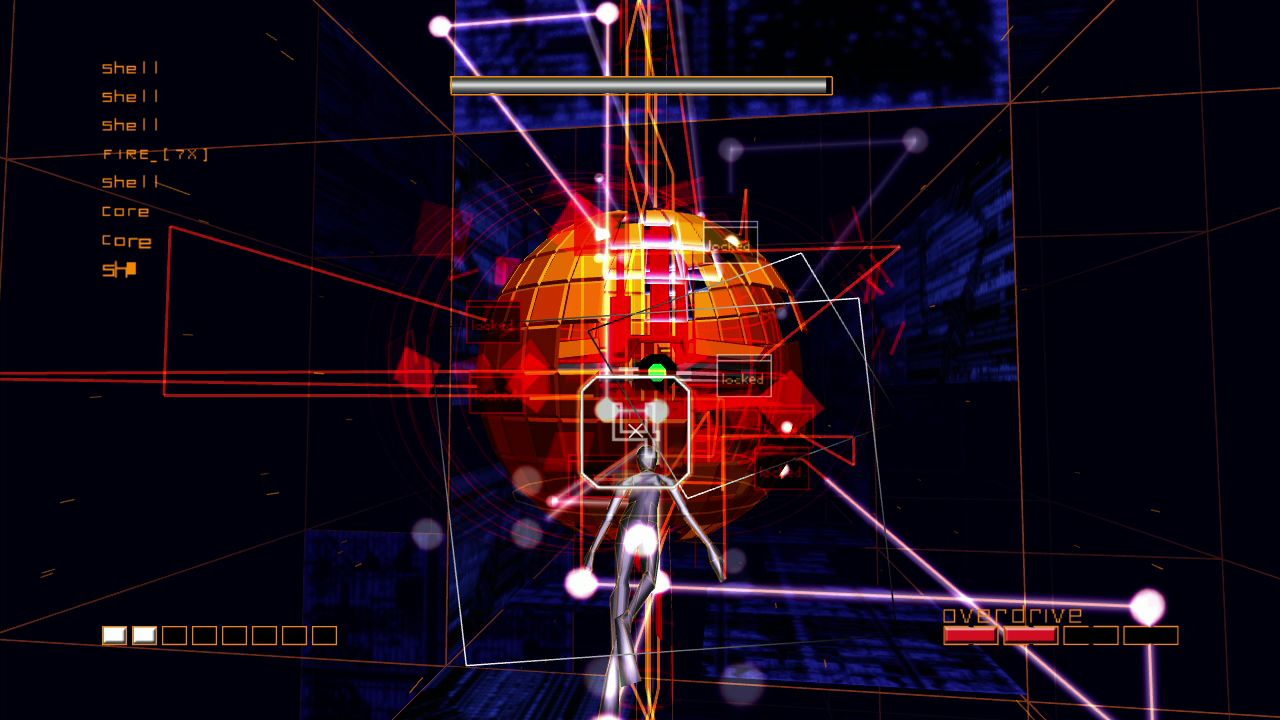
Rez is the point where rail shooters and music games collide. Designed by Tetsuya Mizuguchi of Lumines and Meteos fame, this 1998 Dreamcast/PlayStation 2 game was re-released in HD for Xbox Live Arcade a few years ago. And if you love raves, trance music, and/or do a ton of drugs, Rez is for you. It's a sensory overload.

In a way, Rez is a true successor to Tetris. Like the seminal Soviet puzzler, Rez consists of completely abstract graphics. In Tetris, you control arbitrary colorful blocks falling in an arbitrary pit. In Rez, you control an arbitrary cyber-person shooting arbitrary colorful flying objects. Both games have marginal stories imposed onto them, but plot doesn't matter at all in either game.

And much like Tetris, enjoyment of Rez depends largely on rhythm. Now I know what you're about to say: "But Jake, Tetris isn't a rhythm game!"

Oh, but it is. Tetris is the consummate casual game: you can play it for two minutes, or you can play it for two hours. The reason we're able to fall into a Tetris trance for so long is the rhythm. The Russian soundtrack is classic, but even without the music, players get into a certain groove clearing line after line of blocks.


Rez is the same thing on drugs. The rail shooting isn't an exciting game mechanic, and the enemies are repetitive. But players get into the same groove playing this game that they do playing Tetris.
Mizuguchi takes the rhythmic play to the next level. Rez's levels have psychedelic visuals and a pumping trance music soundtrack. Perhaps the most notable aspect of this rhythm, though, is the vibratin'.


Whether it's the force feedback of shooting a gun in Call of Duty or the pang of hitting the post in FIFA, tactile feedback through the vibration feature of modern game controllers is something players often overlook, but when used correctly, adds to the game experience.
Rez utilizes vibration perhaps more than any game before or since. A subtle buzz accompanies the beat of the game's music, along with the rumble of shots fired. But it doesn't end there. In Rez, players can activate multiple controllers for the sole purpose of "trance vibration"--each controller vibrates for different purposes. It's a genius concept, and more than a little suggestive.

I'd love to see games in the future vibrate the same way Rez does.