Showing posts with label film. Show all posts

Wednesday, July 6, 2011

Trollhunter would make a fantastic video game.

If you haven't seen the rollicking Norwegian monster flick Trollhunter (Trolljegeren), do yourself a favor. It was released last year in Norway, although it didn't hit U.S. theaters until this past month--if you're in the D.C. area, the E Street Cinema is still showing it until the end of the week!

André Øvredal's Trollhunter is about exactly what it sounds like it's about--a guy who hunts trolls. The handheld camera and giant monsters immediately bring Cloverfield to mind, but it's a vastly superior film. It's got the action and scares, but it's also got a lot of humor, and uses Norway's extensive troll folklore to make the titular creatures more compelling.

While watching the movie, all I could think of was "this would make a fantastic video game." I know, movie tie-ins rarely work out, but in my theoretical game world, it would be perfect! Warning: minor spoilers ahead, but hear me out:

You play as Hans, the Norwegian government's official Trollhunter. It's a Ghostbusters-meets-Men in Black sort of job; you've got to get rid of trolls that travel outside their territory, while at the same time covering it all up and making sure the public doesn't learn of their existence.


Since trolls only come out at night, the game is split into night and day. During the night, you hunt trolls; during the day, you cover up your tracks and stock up for the next night of trollhunting. The nighttime gameplay would be similar to that of a first-person shooter, but instead of a traditional gun, Hans carries a sort of "light gun." Trolls' biggest weakness is sunlight, so Hans must expose them to UV rays with the light gun, similar to a big camera flash bulb.

As we learn in the film, there are several different varieties of trolls, so there are different ways to approach each breed. This will help diversify the light gun mechanic, and provides a natural video game progression courtesy of the film's story. The movie's characters go from encountering a small (tree-sized) troll to facing a 300-foot behemoth, which sets itself up almost too perfectly as the final boss of the game.

During the day, Hans hides it all, and moves on to the next one. This is like a detective game in reverse, making sure the general populace is unaware of what happens at night. While some trolls explode when exposed to sunlight, older ones simply turn to stone. Hans breaks down the stones and turns them to gravel. Any damage incurred by trolls (half-eaten farm animals, destroyed power lines) gets covered up as bear attacks or freak tornadoes. Hans then prepares for the next night, by setting up traps and re-stocking supplies.

Hans' Land Rover is another critical part of the film and the gameplay. It's where he stores all his trollhunting gear and navigates the sweeping locales of Western Norway to get to the next one. Finding trolls is an art of its own--finding cryptic newspaper articles, examining the landscape for hints of troll activity. The Land Rover is a big part of that. But it's also used in battles against the trolls themselves; he upgrades it and outfits it with protective spikes and a giant troll-fighting UV searchlight.

One last element of the film to incorporate into the game is one of trolls' stranger abilities: being able to "smell the blood of a Christian man." One of the characters in the film is indeed a Christian; while everyone else sneaks around at night mostly unnoticed by the trolls, the Christian character must constantly cover himself in "troll stench" to prevent them from easily sniffing him out. This could translate to nifty stealth mechanics in the game, although it would be a fine line to tread. Poorly-executed stealth sections can ruin a game.

There you have it. Why Trollhunter would make a superb video game, and a bit of a promotion of the film itself in the process. Go see it.

Saturday, August 14, 2010

Scott Pilgrim vs. the World is the best film I've seen all year.

I didn't have high expectations going into the theater to see Scott Pilgrim vs. the World. It got mixed reviews from critics, and cinemas are billing it as a kids' movie. But as it turns out, Scott Pilgrim is the best film I've seen all year. Edgar Wright, Canadian indie rock, and endless video game references add up to a film right up my alley, even if it may not be middle-aged Washington Post critics' cup of tea. After all, you can't create decent art without alienating someone.

Mr. Wright, of course, is the director of two of my favorite films of all time: Shaun of the Dead and Hot Fuzz. His signature geeky attention to detail and super-fast cuts are present in Scott Pilgrim; you can tell he had a lot of fun making this movie. Michael Cera plays the titular character, the bassist in a mediocre Toronto garage band called Sex Bob-omb (a great Mario reference already). He falls in love with a girl who makes him fight her seven evil exes to date her. These are pretty much Scott Pilgrim's equivalent of bosses at the end of each level in a game. The film is full of colorful action sequences which are stuffed with video game homages, complete with bad guys evaporating into coins when they're defeated. Considering the movie is tongue-in-cheek, the fight scenes are surprisingly well-choreographed. Even though Pilgrim is a mopey little hipster, his uber-fast punches and roundhouse kicks to the moon reach martial arts film-caliber quality. This trailer doesn't do the movie justice, but it gives you a good idea of the combat sequences.


The film's structure, ample nerdy pop culture references, and completely over the top style remind me a ton of Japanese indie game developer Suda 51's fantastic-and-polarizing No More Heroes series. But Wright weaves these unrealistic, almost dreamlike sequences with the realistic character-driven scenes seamlessly.

Other than the Mortal Kombat-style graphics accompanying the fight scenes are a few more subtle video game references. One of Scott's friends plays The Legend of Zelda on his Nintendo DS throughout the movie, and you can hear the game music in the background of a few scenes. In one of Scott's dream sequences, the Zelda song in the background morphs into a fantastic orchestral composition.

As I said before, music is at the center of Scott Pilgrim. In addition to a soundtrack full of Canadian indie stalwarts like Broken Social Scene and Metric, music plays an important role in the story. Scott's band, Sex Bob-omb, must play a Battle of the Bands organized by a mysterious record producer named G-Man (a Half-Life reference?), so many of the fictional musicians in the movie actually play music the audience gets to hear. Some critics of the film complained that considering music plays such an integral role, they wish there were more "hummable" tunes to walk out of the theater with. But that misses the point entirely of indie rock written in the basement of a twenty-something in Toronto.

When I tweeted "Scott Pilgrim is the best film I've seen all year," I immediately got many responses of "OMG WHY NOT INCEPTION???" I suggest those people read my review of that film. Inception was a great concept with not-so-great execution. Its Achilles' heel was that it tried make everyone love it. Scott Pilgrim vs. the World, on the other hand, doesn't want to please everyone. If you don't play video games, don't listen to indie music, and/or are over 40 years old, you probably won't like this movie. And that's the way art should be.

Monday, August 9, 2010

Sci-fi closer to reality than you think: District 9

When District 9 came out a year ago, it was lauded for its biting social commentary, an allegory for South African apartheid. It was a big step forward in the maturation of the science fiction genre, using extraterrestrials not as campy bad guys but as sympathetic, layered characters. The story--aliens stranded on Earth who are forced to live in slums in Johannesburg--could have taken place in any number of major cities in first-world countries, from New York to London to Tokyo, and turned into an Independence Day-style action movie. But the fact that it takes place in South Africa adds a whole new dimension not seen very often in cinema.

First-time director Neill Blomkamp based the film off a 6-minute short film he made called Alive in Joburg. The pseudo-documentary style, which was later used in District 9, features a number of interviews with South Africans about their feelings towards the aliens. In Alive in Joburg, most of these interviews aren't fake; they're actual interviews with real South Africans about their feelings toward Zimbabwean refugees in the country.

This realism carries over to District 9, where the slum the "prawns" are forced to live in wasn't created for the film. It was a real recently-evacuated neighborhood of impoverished housing, and like the prawns, the real-life residents of these shacks had been evicted to move to government-subsidised living areas.


The prawns are about as horrific as you can get. They've got little arms coming out of their stomach, they lay eggs that nurse on animal corpses, and they've got repulsive tentacles for mouths. But they've got redeeming qualities beneath it all. Despite their disgusting appearance, the prawns have very human-looking eyes, they've got a few quirks like their intense love of canned cat food. By the end of the film, it's these ugly aliens the audience identifies with, and the humans who turn out to be the oppressors. Even the main human character's name is Wikus van de Merwe, while the main alien character is... Christopher Johnson.

What really sticks with me is the performance of Sharlto Copley as this human main character, Wikus. At the beginning of District 9, he's a huge dick. A weaselly Afrikaner paper pusher working for a shady multinational military contractor, he's assigned to lead the relocation of the prawns from Johannesburg to a giant internment camp outside the city. He looks down on the prawns, laughs about killing their babies, and in general represents greater society's negative view of the (literal and figurative) aliens. He's the worst kind of person.

Over the course of the film, though, we as the audience empathize with him. But it's not because he ceases to be a douche. He doesn't. Even when he sticks it to the Man and helps the aliens, it's only because he wants them to help him in return. But it's those shades of gray in which we find his humanity. What District 9 accomplishes beautifully, other than the sweet Afrikaner accents, is this idea of finding the good in the bad.

Sharlto Copley had never done any professional acting prior to District 9; this solidifies my view that famous actors are a farce. No matter how brilliant Brad Pitt is, you can always find an unknown who will do just as well for a fraction of the cost, which you can then spend on things like "improving the film." But our society needs these stars to feature on movie posters, to get people into theaters to make money for the industry. District 9, however, succeeds without a single famous actor. Sharlto Copley makes me wonder what modern cinema would be like if we didn't need Brad Pitt.

Saturday, July 31, 2010

Let the Right One In: Swedish vampires and their American imitators

With the connotations the term "vampire movie" has garnered the past couple years, I wouldn't say I'm a fan of vampire flicks at all. But 2008's Let the Right One In is a breed apart. It's a beautifully shot, stark film based on a 2004 novel by the same name about kids growing up in a snowy town in the early '80s. Låt den rätte komma in, as it's known in Sweden, was a surprise hit outside of its home country, and won a ton of awards all over the world for a relatively unknown director named Tomas Alfredson.

Only two years later, a U.S. remake is in the works, and fans of the original film are crying foul. Americans are dumb and don't want to read subtitles! They're totally ignorant of the rest of the world! They don't appreciate good cinema! The makers of the upcoming American version, known simply as Let Me In, say it's based on John Ajvide Lindqvist's novel and not the first film adaptation, which means it will be different from Let the Right One In. But the first trailer for the remake has been released, and it seems eerily similar to the original Swedish film. Even the actor who plays the main character looks so much like his Swedish counterpart (albeit with brown hair instead of blonde), it's uncanny. Let's take a gander. Here's the trailer for the original Swedish masterpiece:


Now here's the trailer for the upcoming American Let Me In, set to be released October 1st of this year:


Pretty similar, eh? Some are even calling it a "shot-for-shot remake." But before we jump to all these conclusions, let's get some perspective. American remakes of foreign-language films that were released only a few years before isn't uncommon, and it isn't always a bad thing. Martin Scorsese's 2006 film The Departed is often cited as one of the greatest movies of all time, and it's a remake of a Hong Kong flick from only four years earlier called Infernal Affairs.

So although I'll be a huge skeptic, I'm sure I will go see Let Me In as soon as it hits theaters in October. After all, it is directed by Matt Reeves, the man at the helm of Cloverfield. A lot of people weren't a fan of the handheld monster mash, but it's one of my favorites. Even if it's not as good as the original (and it probably won't be), I'm sure Let Me In won't be a simple shot-for-shot remake.

While I'm on the topic of Let the Right One In, I'd like to take a moment to greedily cross-promote and show you a video I made last year. If you haven't seen the movie, it won't make much sense, but if you have, I've taken the original and put together an all-new trailer, turning it into Christmas Family Fun for All without actually changing any of the shots.

Tuesday, July 27, 2010

Inception: A flawed psychological beauty

I was skeptical going into the theater last night to see Christopher Nolan's latest work, Inception. It's nearly impossible to shake the Batman connotations. He's the same guy who directed 2005's highly-acclaimed Batman Begins and 2008's orgasmically-acclaimed The Dark Knight. I'm skeptical because although I really liked The Dark Knight, I didn't think it was the greatest film of all time, like many seem to believe it is. To make matters worse, the primary Inception theatrical poster is nearly identical to one of The Dark Knight's theatrical posters.
I hoped this wasn't just cashing in on Batman's (or really, the Heath Ledger's) success. After all, the premise was intriguing: manipulating dreams. And the film features one of my biggest man-crushes, Cillian Murphy of 28 Days Later fame. And the week of the film's release, it was universally praised by critics. So I thought I'd finally cave in and see it.

It's a great film. The psychology of it all immerses you in the experience and makes you really think deeply about it. The characters talk about a lot of things pertaining to dreams that we've all contemplated but not put into words. The idea that when you sleep for five minutes, your dreams can feel like they last an hour. The idea of never remembering how dreams begin: we always start in the middle of everything, in medias res. And there are always things we know are wrong--your girlfriend's hair is red instead of brown, or everyone has three arms--but we don't really think about the fact that they're wrong until after we wake up. The film explores how while we only use a fraction of our brainpower when we're awake, we can use it all when we're asleep, because we're fully connected to our subconscious; we can dream as fast as we can think.


The crux of the story revolves around controlling one's dreams, actively using your subconscious to shape the dreams however you want. In addition, there's this concept of "shared dreams," where you can go into someone else's dream and interact with it. However, the more you disturb their dream, the more their "projections" of people within the dream will realize you don't belong there, and become hostile. People don't leave this dream world unless they wake up in real life, or die in the dream.
Unfortunately, Inception falls into both the trappings of being a Hollywood film, and earning a PG-13 rating. Hollywood means the film is full of stars: Leonardo DiCaprio and Ellen Page play the leads. While they don't ruin the movie, they're not exactly riveting actors either. And while the film's concept seems like it would provide endless possibilities for crazy dream scenarios, the accessible mainstream nature of the movie means instead of acid trips or social statements, the dreams the story takes place most in are...

  • A car chase through New York City

  • A fight in a fancy hotel, and

  • An attack on a snowy military base.
Because we haven't seen those scenarios thousands of times before in cinema. An immaculate idea becomes a wasted opportunity, as the characters spend most of the time doing things they could've done in the real world without this sweet dream-controlling ability.

I'm also disappointed Inception went for a money-making PG-13 rating. "But Jake! The Lord of the Rings, your favorite movies of all time, are PG-13!" you may retort. But not all PG-13s are created equal. The Lord of the Rings was based on an epic fantasy tale written in the '30s and '40s, and published in the '50s. It was great filmmaking without needing more blood and swearing or more controversial, risky decisions--making such an epic film trilogy in the first place was risky enough. Inception, on the other hand, is a modern psychological thriller written for the 21st century. Yes, people actually bleeding when they get shot would have been nice, but I truly believe this film could've been so much more with an R rating. The dreams could've been made more disturbing and "out there," the subplot involving DiCaprio's character and his deceased wife could have been much deeper and more twisted, and Inception would've benefited as a whole. Instead, Nolan & Co. went for PG-13, because adults would still see it while at the same time capturing the lucrative "teenagers spending their parents' money" demographic.
In the end, though, I can overlook these faults because if you just take Inception for what it is and roll with it, it's an engrossing film experience. Its psychology is thought-provoking, and the concept makes you walk out of the theater thinking about it more. I'd be willing to bet if I watch this movie a second time, I'll get more out of it, and that's the sign of good cinema. Plus, Sir Michael Caine appears in a couple scenes, and he's one of my favorite people ever. It's not a Picture of the Year, but Inception is worth a viewing or two.

Sunday, July 25, 2010

City of Men: City of God Lite

About a week ago, I reviewed City of God. It was a sprawling 2002 epic about the slums of Rio, and one of the most renowned Brazilian films of all time. Its success led to a TV show called City of Men which ran for four seasons, and in 2007 was adapted into this film of the same name. Fernando Mereilles has moved from director to producer, and the two lead actors carry over from the first film.
City of Men is very well-made. The cinematography in particular is stunning--there are some beautiful shots of the shanty towns lit up at night that were not present in its predecessor.
But unfortunately, it lives in its predecessor's insurmountable shadow. City of God's scope was wider, its message was stronger, its characters more memorable and its child violence more disturbing. City of Men is a great movie, but it would be like making a "pretty good fantasy film" as a spiritual successor to The Lord of the Rings.
City of Men is a solid film on its own and out of filmic context, but in relation to what came before, it's merely a supplement. I started the movie expecting "not nearly as good as the first film, but still good," and that's exactly what I got. The problem with masterpiece cinema is figuring out what comes afterward.


Sunday, July 18, 2010

City of God: Brazilian Lord of the Flies


City of God is one of my favorite films because it features children getting shot.
Not that I enjoy watching kids get hurt. It's pretty traumatizing, in fact. But I love what onscreen killing of minors represents.
It shows director Fernando Meirelles doesn't pull punches. This 2002 drama about the slums of Rio de Janeiro is gritty, dark, and depressing, everything a slum movie should be, to the point of making the viewer feel uncomfortable. And it's beautiful.
The film (Cidade de Deus in Portuguese) is rated R, but even still, if I were a distributing company or a movie theater, I think "murdering small children" would be pretty high up there on my Top Ten Things Not to Show Audiences list. Meirelles could've easily taken this scene out of the movie and still had a great piece of filmmaking, but he foregoes potential profits for realism and artistry, and I respect that enormously.


The story follows a kid named Rocket growing up in the "City of God," as the slum is named, in the '60s and '70s. Rocket just wants to leave and become a photographer. But he's surrounded by crime. Although he's the main character and narrator of the film, he really isn't the focus of the movie. He's a vessel for the audience to see what goes on in the Cidade de Deus, children learning to fire a gun almost as soon as they learn to walk. Some kids want to get out, others embrace it; all of them are swallowed up in the violence. The rich people want nothing to do with them, the cops are corrupt, and the children are left to fend for themselves.


There really are no significant adult characters in City of God. Cars are held up by young children with pistols, and the drug cartels and gangs are all created by teenagers. A 12-year-old kid asserts,

"A kid? I smoke, I snort. I've killed and robbed. I'm a man."

The film asks the question, does this make you a man? I couldn't help but think of the endless connections to William Golding's Lord of the Flies. Kids are thrown into the wild and left to their own devices. Trying to create some sort of organized society, they end up killing each other. It's a very Thomas Hobbes way of looking at the world. And as City of God illustrates, it's incredibly circular. If one drug lord is killed, another will take his place. It never ends. Warriors forget why they're fighting, only remember that they have to fight. And it continues to this day.

Friday, July 16, 2010

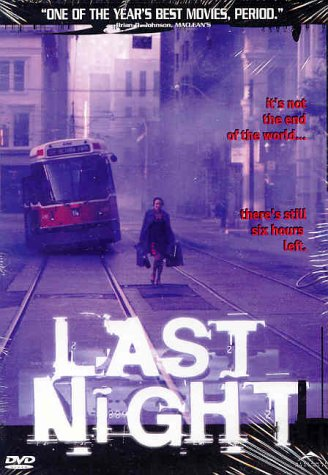
Last Night: A more subtle end-of-the-world movie


Last Night is a 1998 film about the apocalypse. But it's not a Dawn of the Dead, I Am Legend, Mad Max sort of explosive movie about the end of days--it's Canadian.
"What are you implying?" you may implore. "That Canadians are boring?"
Not at all. I'm implying there's depth and nuance in this film you can't find in most American armageddon cinema. It's about how people come to terms with the end of time.
The premise is "the world is ending in two months," and this movie chronicles the final six hours, as experienced by a handful of people throughout Toronto whose lives become intertwined over the course of the film.


I discovered Last Night a few years ago while reading analysis of 28 Days Later, one of my favorite films of all time. If you liked that movie, this Canadian cacophony is right down your alley... albeit with 100% fewer zombies.
Since all the characters have known about their impending doom for some time, they're done panicking and screaming. They've had to decide where to spend their last night.
A family recreates their fondest memories with a faux-Christmas. The owner of a gas company calls every one of his customers and thanks them for their business. A man spends the night looking to fulfill every sexual fantasy he's ever had. Some people just decide to party to the end. Watching Last Night you can't help but ask yourself, "Where would I spend my last night on Earth?"


The film is full of humor set on an incredibly depressing backdrop. Main character Patrick is played by a stellar Don McKellar, who also wrote and directed the film. He wants nothing more than to spend his final hours alone with music and wine. Instead, he gets stuck spending the night helping a stranger look for her husband. The stranger is played by Sandra Oh, in one of her breakthrough roles before she became a star in the United States with Grey's Anatomy and Sideways.

How the world is going to end is never explained; all we know is that as it gets closer to midnight, it gets brighter and brighter outside, perhaps hinting at a "sun exploding" situation. But the reason for it all isn't important--the focus of Last Night is on the people at the end of the world, not the world at the end of the world. Spending valuable exposition time explaining the reason for the apocalypse would take away from the true meaning of the film--what it really means to be human.