Showing posts with label Metro 2033. Show all posts

Tuesday, May 28, 2013

Metro: Last Light review

A while back I reviewed Ukrainian developer 4A Games' cult hit Metro 2033. Based on a series of bestselling Russian novels, Metro was one of my favorite games of 2010. It was flawed, but it was beautiful.

Now the Kiev-based studio is back with a sequel, Metro: Last Light. Despite its publisher THQ giving the studio a tiny budget, imposing terrible working conditions, and folding a few months later, 4A persevered. The game was picked up by German publisher Deep Silver and released earlier this month.

Metro: Last Light serves as a natural progression of Metro 2033. It's set in post-apocalyptic Moscow, where the surface is irradiated and survivors live underground in the tunnels city's Metro system... hence the title. You play as Artyom, a man dealing with the guilt of his murderous past. Guilt is one of the driving themes of the entire story, something carried through until the end credits.

I've had a lifelong love of both post-apocalyptic stories and public transit systems--subways in particular. So Metro is right up my alley; Fallout 3 is perhaps my all-time favorite game largely because of its post-apocalyptic version of my hometown Washington, D.C. Metro system. Last Light's Metro is based on the real-life Moscow Metro with its distinctive circular routes, and it'd be really interesting to take a trip there and see how closely the in-game locations match their real-life counterparts.

If you haven't played the original game, you won't understand much of the plot line, and that's a good thing. Instead of spending the opening hours of the game on exposition introducing you to the characters and setting, Last Light is able to jump right into the meat of the story.

Last Light is also a natural progression from 2033 in terms of gameplay and mechanics. It definitely feels tweaked and upgraded all around, but the core gameplay loop of Metro remains intact.


The game has been described as "Fallout meets Silent Hill." It mixes survival-horror with FPS and stealth mechanics, and the combat is serviceable enough. You've got a wide range of ways to approach obstacles, from ninja-like creeping to Rambo blazin'.

The most interesting gameplay mechanic is the gas mask, carried over from 2033. Anytime you venture to the surface of Moscow, you need to wear a gas mask. You need to make sure you have enough air filters, and you have to manually switch filters when one runs low. Combat has its effects on the mask, cracking the glass and making it harder to see. You can take filters and gas masks from corpses you find around the city if your current one is banged up.

I love to play games slowly and savor the experience, and at first I thought this gas mask stuff would be an unnecessary time-limiting annoyance when I'm trying to survive in an already-hostile world. But in practice, it enriches the experience and made me feel more immersed in the dystopian gameworld. It added the "survival" aspect to "survival-horror." You can survive on the surface for a minute or so without a mask, and some of the most intense experiences I had with Last Light were when I was frantically rushing around the surface sifting through rubble to find a new air filter for my mask.


Luckily, Metro is a series made for slow gamers like me. Where the game truly shines is in the downtime at the various Metro stations around Moscow. It's not an RPG, but you're free to explore the heavily-populated stations at your leisure. Unlike many games in which NPCs have fake conversations for a few seconds, in Metro, you can sit and listen to random underground citizens talk to each other for minutes on end. You don't need to listen to any of them, but if you do, it enriches the game's fiction and makes you feel like part of a larger world.

Friday, November 16, 2012

Global Gaming Spotlight - S.T.A.L.K.E.R.: Shadow of Chernobyl (Ukraine)


With each post in this mini-feature, I highlight a game from a different country around the world. Keep in mind these aren't necessarily the best or most popular games from each nation, but simply a fitting representative.

S.T.A.L.K.E.R.: Shadow of Chernobyl - GSC Game World, 2007

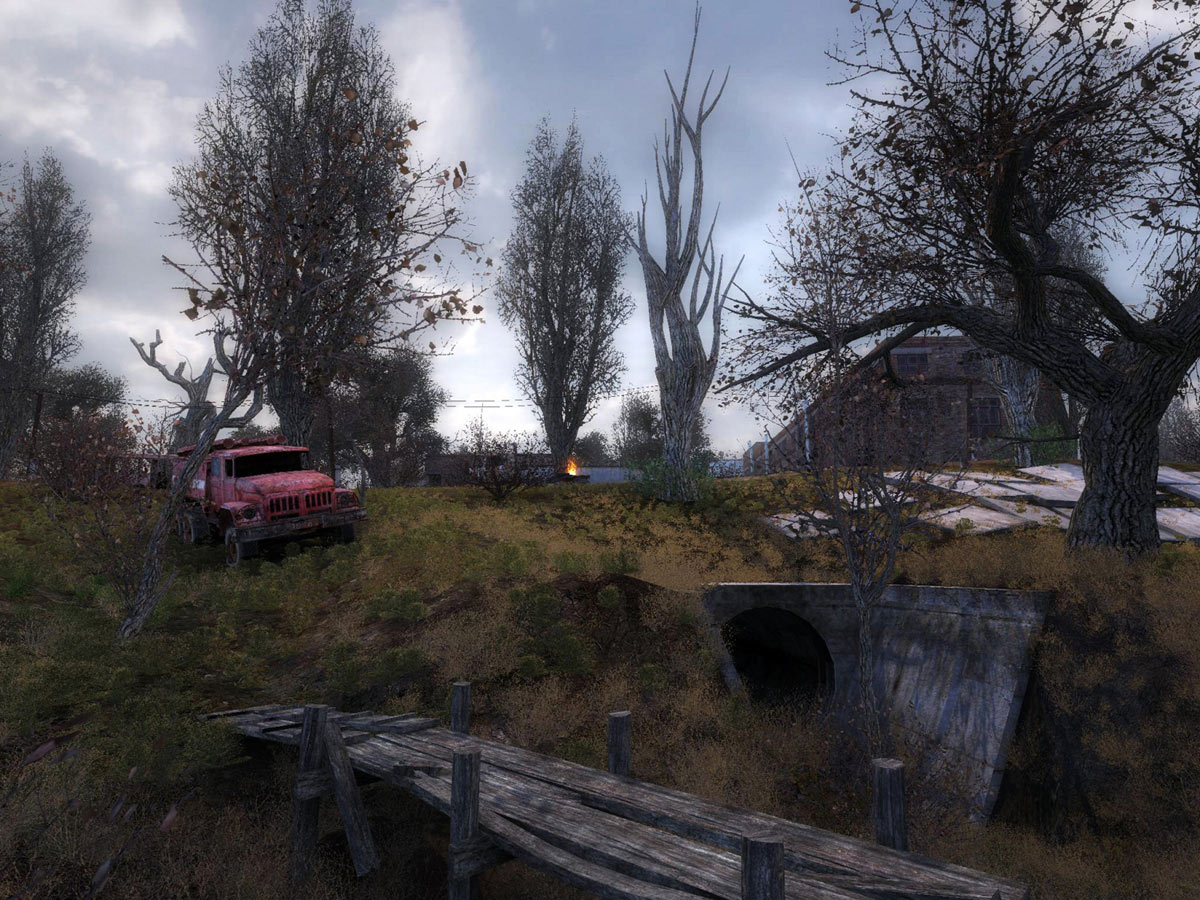
Ukraine is outpacing its former overlord in game production these days. And they seems to have the "post-apocalyptic survival-horror first-person shooter" genre on lock. I really wanted to feature one of my personal all-time favorites, 4A Games' Metro 2033, for the Ukraine global gaming spotlight. But Metro is based on a Russian novel, and takes place in the subway tunnels of Moscow. S.T.A.L.K.E.R.: Shadow of Chernobyl, on the other hand, takes place in... Chernobyl, one of the most globally significant places in Ukraine.

GSC Game World's title is an open-world affair, which is rare for horror. Usually, horror (whether it's in games or film or anything else) depends on a very linear storyline so the audience gets scared by exactly what the creators want them to get scared by, at the exact right time to maximize creepy pacing.


On top of that, open-world games are often "jacks of all trades, masters of none" because they have to render such a huge amount of content for players to experience. This doesn't seem like the ideal approach for scaring your audience. But Shadow of Chernobyl somehow makes it work.

Shadow of Chernobyl achieves its goals by relying on emergent gameplay. When the player isn't told what to do, they can often scare themselves--we see this in Slender, and even to a certain extent in the creepy procedurally-generated underworld of Minecraft. Because the player isn't always sure where they're meant to go, they often peek into the most horrifying of places they didn't even know existed.

I've recently fallen in love with Eastern European game design. It makes sense that the whole "former Soviet republic" thing, combined with the legacy of Chernobyl, make for some melancholy post-apocalyptic choices by Ukrainian studios.

The Global Gaming Spotlight so far (zoom out for full map):


View Global Gaming Spotlight in a larger map

Friday, February 10, 2012

Horror and guitars in Metro 2033

I just finished Metro 2033, a 2010 adaptation of the 2005 book by Russian author Dmitry Glukhovsky. Created by Ukrainian developer 4A Games, Metro 2033 is one of the most chilling games I've played in a long time.

The game tells a tale of post-apocalyptic Moscow, where people are forced to live underground in the Metro stations. The structure reminds me of Fallout 3 crossed with Half-Life 2, but with a distinctly Slavic perspective.

It's interesting to play something made in Ukraine. Most video games are either North American or Japanese. Not many are European, and even fewer are Eastern European. The result is a work that could not be replicated in the United States or anywhere else.

Metro 2033 isn't perfect. It's got all the trappings of a survival-horror FPS, and there are some sections that take control away from the player when they should've just let the player experience them on their own, Valve-style. But Metro 2033's atmosphere is melancholy in a way I haven't experienced before. The narrative doesn't spoon-feed you the emotions you're meant to feel as you play through the storyline. Instead, the claustrophobic settlements in the subway stations and the stark icy dystopia of the Muscovite surface seep into the player's psyche. On top of it all, there's a supernatural subtext that's handled beautifully.

The Metro stations are by far my favorite part of the game. Cramped and full of dirty, tattered survivors, these ramshackle subterranean villages provide context for the graveness of Moscow's holocaust. There's no way to "interact" with most of the civilians, per se. Instead, all you can do is walk around and observe these people live their dreary underground lives. The dialogue between all these non-player characters is inconsequential to your story, but they add layers and layers of personality to the world of Metro 2033.

The voice acting here is some of the best I've ever heard in a game (both in English and in Russian--you can play through the game with either audio track), and perhaps because of the work's roots as a novel, the writing is beautiful. Hear two children speculate about what the surface of Moscow (which they've never seen before) is like, or listen to drug addicts argue over their stash. There's nothing tangibly beneficial to you in the game world for listening to these conversations other than to deepen your understanding of the story you're in.


There are a few curious inclusions in these subway towns. First of all, almost every settlement you visit includes someone playing music. There are guitars and other instruments strewn around the game world. And second, there are kids everywhere. Most video games feature few to zero children, but these Metro stations are full of kids. And in a way, it's very unsettling. Will these children ever have a future? Their lives are full of darkness and death.

Which brings me to Metro 2033's understatedly brilliant morality system. Many games have a metered "good or evil" morality bar where doing the right thing or the wrong thing provide clear gameplay advantages and disadvantages. Metro 2033, on the other hand, never tells you it's keeping track of the decisions you make. And instead of obvious "kill this person or spare their life" moral choices, the game judges you on a plethora of tiny decisions. Do you stay and listen to the old lady begging for food? Do you linger in a place and play the piano? These little choices change the trajectory of the story without your knowledge. Really, that's a truer "morality" system than "choose obviously good decision for ___ benefit."